
SEO (search engine optimization) earns rankings and clicks on classic results pages. GEO (generative engine optimization) earns citations inside AI-generated answers in ChatGPT, Perplexity, and Google AI Overviews. The content foundation overlaps. The scoreboard doesn't: Writesonic's study of 1 million AI Overviews found only 40.58% of citations come from Google's top 10.
Google returned 98 results for "geo vs seo" on July 9, 2026. They span 86 distinct domains. Sixty-one of the titles lean on "difference," "different," or "differ." The top organic listing is none of those explainers. It's a Reddit thread in r/SEO asking what the difference is.
- 40.58% of AI Overview citations come from Google's top 10 — rankings buy a real head start.
- 7 of the 10 most-cited domains in AI answers are UGC platforms, not publishers.
- AI Overviews cut CTR by about 60% — but only on roughly 1 in 5 queries.
- Meta descriptions and JSON-LD don't reach LLM crawlers: 9 of 11 metadata types scored zero.
- Fund GEO as an extension, not a replacement — the SEO substrate feeds both scoreboards.
The author keeps "seeing titles and thumbnails about how AI has completely changed the way we approach SEO." Sixty-one explanations ranked below the unanswered question. That's the market failure this page is built not to repeat.
The results page is its own best exhibit. An AI Overview answers the query at the top. That's the surface GEO optimizes for. A user thread outranks 85 domains of expert content. That's a citation factor doing its work in public.
Under both, Semrush, agencies, and tool vendors trade positions. That's the SEO game, still running, still worth money. One page, three layers. The split is visible before you read a single guide.
Here's what this page holds. The ranking factors vs citation factors table. The documented data on where SEO clicks went. A transfer verdict for each asset in your SEO stack. A decision framework for funding both.
The terminology war lives on the AEO vs GEO page — who coined what, and the vendor claim that the acronyms all mean one thing. This page stays on the SEO side of the fence.
The short answer: one foundation, two scoreboards
SEO optimizes pages to rank in organic search results and earn the click. GEO optimizes your brand to be retrieved and named when a model writes the answer. The on-page work overlaps heavily. The ranking factors vs citation factors split is where the disciplines separate — and where most of those 61 explainers go vague.
| Lever | Ranking factor (SEO) | Citation factor (GEO) |
|---|---|---|
| Authority | Backlinks from trusted domains. | Consistent entity mentions across sources — linked or not. |
| Query unit | A keyword with measurable volume. | A prompt the model splits into sub-queries via query fan-out . |
| Selection | A position on a SERP you can watch. | Retrieval into the source set the model writes from. |
| Engagement | CTR and dwell time feed rankings. | The model never sees your bounce rate. Extraction clarity replaces engagement. |
| Metadata | Title, meta description, schema for rich results. | Title tag only — 9 of 11 metadata types scored zero in an April 2026 crawler test. |
| Off-site | Referring domains and anchor text. | UGC presence — 7 of the 10 most-cited domains in AI answers are user platforms. |
| Freshness | Crawl and update cadence. | Dated, quotable statistics — the unit models lift into answers. |
| Scoreboard | Positions and organic traffic in Search Console. | Citation frequency, AI share of voice , average mention position. |
The AI Overview on this SERP compresses the table into one line. "SEO optimizes for ranking and clicks; GEO optimizes for selection and AI citations." Semrush's guide draws the same line from the content side. "SEO content is built to rank in search results. GEO content is built to provide a direct answer."
That's the fourth organic listing, published November 20, 2025. Both statements are correct. Both describe outputs. The table above describes inputs — the things you would change on Monday morning.
The snapshot holds one more signal worth naming. Writesonic — the vendor with the most data on this page — sits 20th among the organic listings. The listing that ranks first is a question.
Eight of the 98 titles frame the topic as "both." The market explains differences; almost nobody helps you decide. The decision framework below exists for that gap.
Zero top-10 overlap with the "aeo vs geo" SERP settles a housekeeping question too. Google treats these comparisons as separate topics. So do we. That's why this site keeps three comparison pages, not one.
The scoreboard split also lands differently by seat.
- A marketing lead wants to get cited — the AI Overview naming their guide as a source.
- An SMB owner wants to get recommended — the assistant naming their business to a customer.
- A founder wants to get mentioned — the category prompt including their product at all.
Same table, three different rows to fight for. Which one is yours decides your budget more than any definition does.
One number keeps the "it's just rebranded SEO" reflex honest in both directions. Writesonic's analysis of over 1 million AI Overviews found 40.58% of citations come from Google's top 10 results.
Read it forward: rankings buy a real head start. The SEO camp is two-fifths right. Read it backward: 59.42% of citations come from outside the top 10. Something other than organic rankings picks the sources most of the time. Neither discipline explains that SERP alone.
What SEO still does that GEO can't
SEO still owns the click. Search volume grew 18% year over year in Eskimoz's 2026 analysis. AI Overviews suppress clicks on roughly 1 in 5 queries — mostly informational ones. And AI engines retrieve from Google's and Bing's indexes. Commercial and navigational intent still resolves on a results page you can rank on and measure.
Start with the dependency, because it kills the "GEO replaces SEO" framing on contact. Most AI engines don't crawl the web from scratch for every answer. They retrieve from existing search indexes , primarily Google and Bing. Even Writesonic's own comparison concedes the point. Its section title: "AI Search Still Relies on Traditional Search Indexes."
A page that can't get indexed can't get retrieved. Whatever you call the discipline on top, the substrate underneath is crawlability, canonical hygiene, and internal linking. That's SEO's least glamorous work, unchanged.
The click economy is narrower than the panic suggests. SEO keeps the profitable part. The Eskimoz breakdown shared on Reddit in June 2026 puts AI Overviews on roughly 1 in 5 queries, mostly questions. Transactional and navigational queries still end in a click on something.
"Pricing," "buy," "login," "{brand} review" — none of these resolves inside a synthesized paragraph. The intent match between a commercial query and a ranked commercial page is a conversion mechanism no AI answer replicates. When a buyer is ready to act, the organic rankings still decide who gets the visit.
Local search stays SEO's territory too — with a twist worth watching. A map pack with reviews, hours, and directions answers "plumber near me" better than any generated summary. But assistants now walk that path for the user. A renovation-company owner on r/smallbusinessowner watched Claude hunt for an emergency roofer .
The assistant skipped sites it couldn't act on: "these sites require phone calls, no online booking available." The fix isn't new marketing. It's booking paths, structured info, and current listings — SEO-adjacent plumbing, now read by an agent. The lesson is blunt. A booking link is the new phone number.
Measurement is SEO's third exclusive. Search Console shows positions, queries, and clicks for free. Twenty years of tooling sits on top of it. Nothing equivalent exists for AI answers.
A solopreneur put the asymmetry plainly in February 2026: "With Google SEO, you can at least see your rankings and optimize. But with AI search, it feels like a black box." Citation tracking means sampling prompts yourself or paying a vendor. An honest budget conversation admits this: SEO's feedback loop is instrumented, GEO's is still hand-built.
SEO also compounds on a schedule you can plan. A content calendar maps to keywords. Keywords map to volumes. Volumes map to a forecast your CFO can read. No volume data exists per prompt yet. A citation forecast is still an educated guess. Plans get funded; guesses get pilots.
GEO returns none of these. It can't deliver a click you control end to end. It can't capture a local pack. It can't rank your checkout page. What it does instead is operate in a layer SEO never scored — the next section.
What GEO does that SEO doesn't: the citation factors
GEO works the layer no SEO dashboard ever measured: whether a model names your brand when it writes an answer . Citations concentrate off-site.
Seven of the 10 most-cited domains in AI answers are UGC platforms. And 59.42% of AI Overview citations come from outside Google's top 10. Entity consistency and third-party mentions now carry the weight backlinks used to.
The citation pool looks nothing like a ranked results page. The AI Overview sitting on this query proves it locally. It cites 8 sources. Four of them aren't articles at all: the r/SEO thread, a LinkedIn post, and two YouTube videos.
Half the citation set for "geo vs seo" would never appear in a classic content audit. A classic audit only looks at pages that rank.
The query mechanics explain part of it. Ask an assistant for "the best CRM for a five-person agency." The model splits the prompt into sub-queries — pricing, integrations, reviews, alternatives. It retrieves sources for each. Then it writes one answer from the whole set.
Your page can win one sub-query and still lose the answer. Keyword thinking counts pages; prompt thinking counts appearances across the set.
Zoom out and the off-site pattern holds at scale. Writesonic's 2.4-million-domain citation study covered eight AI platforms from May to October 2025. Seven of the ten most-cited domains are user platforms — Reddit, Wikipedia, YouTube, LinkedIn, Medium. Not publishers.
Reddit alone contributed 678,255 unique cited URLs against Wikipedia's 111,823. The spread is thin: 67.4% of all cited domains appeared on exactly one platform. Only 6.5% reached five or more. The citation game runs on property you don't own. That is precisely the work no SEO retainer includes.
The to-do list that falls out of this is short and unglamorous.
- Claim and update your review profiles.
- Show up in the threads your buyers actually read — under your own name, disclosed.
- Keep your entity facts identical everywhere: name, category, locations, pricing model.
Models reward boring consistency.
Review platforms sit at the sharp end of this. A Seer Interactive study of over 800,000 AI answers found review sites are one of AI's biggest trust signals near a purchase decision.
It caught a darker corollary too. A negative review from 2018 was still being repeated by AI, because the complaint appeared on several review sites. The Whitespark team summarized it in June 2026 in three words: "AI holds grudges." No ranking factor has that memory.
Practitioners keep rediscovering the off-site weighting the expensive way. A SaaS founder ran the test on his own product in May 2026. He asked ChatGPT for the best tool in his category. Three competitors came back; his product didn't — after months of solid Google rankings.
His exact words: "Being indexed by Google doesn't mean ChatGPT knows you exist. Your G2 and Capterra reviews matter more than your blog posts for AI recommendations." A citation factor overruled a ranking factor in a live buying moment.
The inverse case exists too, and it's stranger. In March 2026 an agency reported on Hacker News that two clients found them through Gemini. At the time, their site had zero backlinks, no Search Console property, and not one page indexed by Google.
By every ranking factor they were invisible. They got mentioned anyway — consistent terminology, clear entity definition, topical depth. No SEO model predicts that outcome. The citation factors in the table above do.
Two honesty notes before this reads like a pitch. First, the traffic vs visibility trade is real. A citation often produces no click at all. Its value shows up later, as branded demand and "found you through ChatGPT" intake. Harder to attribute, still money. Second, citations concentrate hard.
An independent tracker ran 3,311 prompts across ChatGPT, Perplexity, and Gemini in January 2026. Of 6,833 mentioned domains, 671 — 9% — took half of all recommendations. Wikipedia alone held 5.15%. On "best investing platforms for beginners," Investopedia appeared 83% of the time. The channel is winnable from a young domain; the Gemini case proves it. The default distribution is still winner-heavy. Anyone selling guaranteed citations is selling against that curve.
The way in is the long tail. Not "best CRM" — "best CRM for a two-person shop that hates dashboards." The big domains can't chase every niche prompt. You can own yours. Win the narrow asks first and let the model learn your name there.
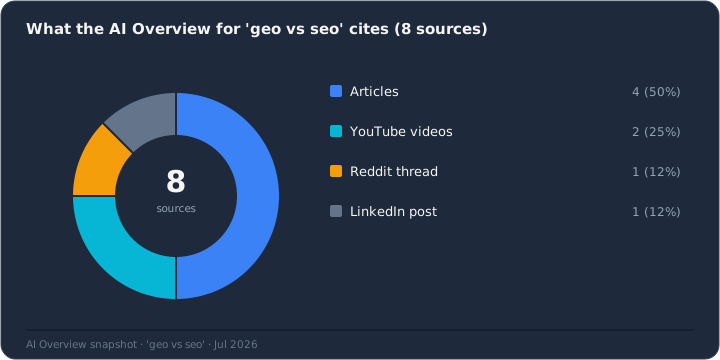
Half the citation set for 'geo vs seo' would never appear in a classic content audit.
Where your SEO traffic actually went: the data
Not to a competitor — to the results page itself. Mid-2025 estimates put 58–60% of Google searches at zero clicks. By June 2026, Eskimoz measured two-thirds ending without a click anywhere. AI Overviews cut CTR by about 60% on the queries they cover. Direct traffic became the #1 source: users take the answer, then navigate.
The anxiety in the community is specific and dated. "After looking google search console, it's clear that CTR is dropped in general," wrote a product builder on r/AISEOTricks in April 2026.
His next step, in his own words: optimizing for answer engines instead. He's reading the same graph thousands of marketers are. Impressions holding, clicks sliding.
The zero-click figures come in two versions, and they don't fully agree. Here are both. An October 2025 r/DigitalMarketing post put it at 60% of searches ending in zero clicks . It also cited the 1.5 billion monthly users Google reports for AI Overviews.
The June 2026 Eskimoz analysis says two-thirds. It adds the three numbers the panic headlines skip. Total query volume: up 18% year over year. The CTR cut of roughly 60%: confined to the ~20% of queries carrying an AI Overview.
Direct traffic: up 3 points, now the #1 traffic source. Eskimoz also logged a rabbit-hole effect — one AI answer breeds the next query, engagement up 5 points year over year. Google is locking attention in, not losing it.
Put together: people search more. They click ranked results less on informational queries. And they arrive at sites directly after getting an answer. The visit didn't die. Its referrer did. The practitioner idiom for this — "the click is now optional" — is accurate as written.
Where the informational click went, a new session type is emerging. One operator published funnel data across 8 early-stage startups on Hacker News. Reaching Google page 1 took ~94 days at a 2.6% organic CTR. Perplexity picked up new content in under 48 hours.
LLM-originated paths grew to 18.2% of sessions — converting 2.4× better than blog traffic. One team's numbers, not a benchmark. The direction is the point: the informational click didn't vanish, it changed carriers.
Your logs can confirm the shift this month. LLM referrers show up as chatgpt.com, perplexity.ai, and gemini.google.com. The counts start small. The growth curve is the signal, not the base. Tag the sources now and let a quarter of data settle the argument.
The verdict for planning: your losses are concentrated, not general. Queries under an AI Overview are where CTR erosion actually happens. Commercial queries still click. Direct and LLM-referred sessions grow in parallel. The future of search, on current evidence, is layered surfaces on one results page. Ranked links, extracted answers, generated summaries — at the same time.
One planning number to keep: the 2.6% organic CTR from the startup dataset above. Compare it with your own Search Console average on info pages. The gap between them is the size of your exposure. So the practical question isn't "switch disciplines?" It's "which assets transfer?"
What transfers: the migration checklist
Most of your SEO stack survives contact with AI search. Crawlability, title tags, content quality, and heading structure transfer directly. Keyword research and link building transfer with a target change. Meta descriptions, JSON-LD (for LLM crawlers specifically), and rank tracking don't transfer at all. Check crawler access first — that layer breaks silently.
| SEO asset | Verdict | What changes |
|---|---|---|
| Crawlable, indexable site | Transfers | Also GEO's substrate. New failure mode: a February 2026 review of a few thousand US/UK sites found 27% blocked at least one major LLM crawler . Usually by accident, at the CDN/WAF layer — not robots.txt. |
| Title tags | Transfers | The only metadata every AI crawler read in r/TechSEO's 60-code test (April 2026, 9 of 11 metadata types scored zero). |
| Content quality + cited sources | Transfers | Both systems reward verifiable sourcing. Models also favor dated, quotable statistics they can lift. |
| Heading structure + internal links | Transfers | Clean H2/H3 hierarchy is what extraction runs on. Add a 40–60-word answer capsule under each H2. |
| Keyword research | Transfers with changes | Keyword targeting vs prompt coverage. Volume exists per keyword, not per prompt. Research shifts to intent clusters and the sub-queries a model fans a prompt into. |
| Backlink building | Transfers with changes | Links still rank you. Citations also count unlinked mentions. The outreach target becomes roundups, review platforms, and consistent entity coverage — not anchors. |
| Meta descriptions, OG tags | Doesn't transfer (to LLMs) | Zero of six AI crawlers read them in the 60-code test. The plain-text conversion strips the head. Keep them for humans and classic-SERP CTR. |
| JSON-LD / schema markup | Contested | Semrush and Writesonic both recommend it. The same r/TechSEO test found AI crawlers stripped it entirely ("Google's own Gemini can't read it"). Keep it for search rich results. Don't count on it alone for citations. |
| Rank tracking | Doesn't transfer | Positions don't predict citations — 59.42% of AI Overview citations come from outside the top 10. Replace with monthly prompt sampling and AI share of voice against named competitors. |
Nothing in this table asks you to unpublish or rebuild anything. That's the practical answer to the "rebranded SEO" objection: the delta is additive. Two rows die quietly, two get re-aimed, five keep working as-is.
Print the table and walk your stack through it, row by row. Most teams find the same three gaps: crawler access unchecked, no capsules, no prompt log. All three are cheap to fix. None of them fixes itself.
The schema row deserves the extra paragraph, because vendor guidance and log-level evidence openly disagree there. The pro-schema camp argues structured data helps engines map entities. The r/TechSEO testers planted 60+ unique codes in a page. Then they asked ChatGPT, Claude, Gemini, DeepSeek, Grok, and Copilot to read it. None read the JSON-LD.
AI crawlers convert pages to plain text before the model sees them. The conversion throws the head away. Both claims can be true at once. Schema feeds the search index that AI engines retrieve from — while doing nothing for the crawler that fetches your page directly. Budget accordingly: schema is cheap insurance, not a citation lever.
Sequence the migration by what fails silently, not by what demos well.
- Week one: verify crawler access — robots.txt, WAF rules, CDN bot settings. The 27% figure says one site in four fails at step zero without knowing.
- Week two: restructure the money pages capsule-first, one direct answer under each heading.
- Weeks three and four: start the off-site pass. Review platforms current, entity facts consistent, one roundup pitch out.
Then stand up measurement: ten prompts, four engines, logged weekly. A GEO audit runs exactly this order against your actual pages and logs. The table above is the generic version. Four weeks, no rebuild.
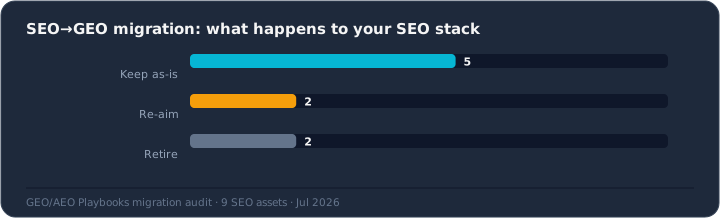
Nothing asks you to rebuild: five assets keep working, two get re-aimed, two die quietly.
Do you need both? A decision framework
You need SEO if customers click; you need GEO if customers ask. Score your exposure on two axes.
One: the share of your queries that are informational — AI Overview territory. Two: the share of purchases that start with "what should I use?" — AI answer territory. High on either axis makes the two complementary strategies, not rivals.
Both axes are measurable this week, with data you already have. The first sits in Search Console. Filter your top queries. Count how many are questions or definitions rather than brand and product terms. Check which ones now carry an AI Overview.
The second sits in your intake notes and review platforms. Count how often new customers mention an AI assistant. Ask sales to log it. If G2, Capterra, or local review sites feed your category, models are already reading them.
A worked example makes the axes concrete. A B2B SaaS with a question-heavy blog and G2-driven deals scores high on both — it needs both disciplines now. A locksmith scores low on informational share and high on recommendation share. Local SEO plus review velocity covers most of the GEO surface already.
A publisher flips the profile: nearly all inventory is questions, and revenue rides on the click. That's maximum exposure on axis one alone. Formatting and citation tracking stop being optional. The point of scoring is that "do I need GEO?" stops being a matter of opinion.
A lawyer on r/LawFirm asked it in the purest form in April 2026. "Would solid Google SEO already cover you or is it a completely different game?" The honest answer depends on those two axes. They differ by business type in predictable ways:
| Business type | Where buyers actually are | Start with | Add GEO when |
|---|---|---|---|
| Local service business (trades, law, accounting) | "Near me" intent still resolves through local results and reviews. Assistants now answer "find me a {service}" directly. | Local SEO + review velocity. | Intake calls mention ChatGPT — or a prompt sample shows competitors recommended and you absent. |
| B2B SaaS | Category prompts ("best X for Y team") are recommendation-shaped. G2 and Capterra feed the models. | GEO measurement alongside existing SEO. The most exposed type on this table. | Immediately. The founder's three-competitors test takes five minutes on your own category. |
| Ecommerce / DTC | Product and brand queries still click. AI shopping surfaces are growing but young. | SEO + product feeds. | Assistants start answering "what should I buy for…" in your categories. |
| Publisher / affiliate | Informational queries — exactly the ~1 in 5 carrying AI Overviews — are the core inventory. | Extraction-ready formatting on money pages. | Citation share becomes a revenue metric. Track AI Overview citations on core queries monthly. |
| Professional services firm | Referral-heavy demand with search assist. AI answers in regulated topics stay cautious. | SEO + entity hygiene: same name, services, locations everywhere. | Clients start quoting AI answers in consultations. |
Two implementation notes keep this framework from turning back into a debate. First, measure before you budget. One month of weekly prompt sampling costs nothing. Your brand plus two competitors, ten prompts, four engines: ChatGPT, Perplexity, Gemini, AI Overviews. It converts the geo vs seo argument into a column of observed mentions. The free AI visibility check automates the first pass.
Second, when the sample shows real exposure, fund GEO as an extension, not a replacement. The hybrid search strategy that survives contact with the data keeps the SEO substrate fully funded. It feeds both scoreboards. The mention layer and the measurement layer go on top.
Write the results down where the CMO can see them. A one-page mention log ends more label wars than any definition post. Keep it simple. Ten prompts. Four engines. One row per week. Who got named, who didn't. That's the whole tool.
The sister comparisons cover the fronts this page doesn't. AEO vs SEO maps which snippet-era skills carry into answer engines. AEO vs GEO settles what the two AI-side acronyms actually name — including the vendor claim that they're one thing.
Answer engine optimization, generative engine optimization, plain old SEO: run the two-axis test above and the label war stops mattering. The budget allocation was the real argument all along.


No comments yet