
AI visibility is how often, how prominently, and how accurately AI answer engines name your brand when users ask questions in your category. The engines: ChatGPT, Perplexity, Gemini, Google AI Overviews . Three numbers measure it: Brand Visibility % (how often you appear), AI Share of Voice (you versus competitors), and average mention position.
Google returned 97 results for "ai visibility" on July 9, 2026. Thirty-seven of the titles contain "tool," "platform," "software," or "tracker". The first organic result in my snapshot is a signup page for a free visibility report.
The query's own AI Overview cites 10 sources. Three of those are tool signup pages too. In short: the people selling the measurement answer the measurement question.
- AI visibility is how often, how prominently, and how accurately AI answer engines name your brand.
- Three numbers measure it: Brand Visibility %, AI Share of Voice, and average mention position.
- The $0 protocol: 20 prompts, four engines, clean sessions, re-run monthly. Time: one afternoon.
- Manual sampling monthly, same prompt set, plus a re-run within a week of a major model release.
- One third-party inclusion beat the entire on-site checklist.
The demand under that SERP is not a tooling question. Its clearest form came from a business owner on r/Solopreneur on February 2, 2026 .
"With Google SEO, you can at least see your rankings and optimize. But with AI search, it feels like a black box. You don't know if you're showing up, how often, or what you could do to improve your chances".
This page is the vendor-neutral answer to that black box. The definition first. Then the three formulas that turn "are we showing up?" into numbers a CMO accepts. Then a protocol that measures yours for $0, what a good reading looks like, and how often to re-check.
One thing this page is not: a tool ranking. Tools get compared hands-on in the AI visibility tools roundup , with methodology attached.
What is AI visibility?
AI visibility is the measurable presence of your brand inside AI-generated answers. Classic search visibility counts positions on a results page anyone can load and verify. AI visibility counts mentions, recommendations, and citations inside answers generated fresh for each user and each prompt. Those answers never appear in your analytics.
The black box has a precise shape. There is no Search Console for ChatGPT. A SaaS founder put the gap in three sentences on r/SaaS in May 2026 . "Google tells you your rankings. Google Analytics tells you your traffic. Nobody tells you whether ChatGPT recommends you when someone asks a buying question".
He then ran the two-minute test on his own product. He asked ChatGPT "what's the best tool in my category?" and got his reading: "My product wasn't mentioned. Three competitors were". Your AI search analytics stop at referral clicks. The answer is where the recommendation happens. It stays unseen until you sample it on purpose.
The signal usually reaches people before it reaches dashboards. An agency operator logged the pattern on r/GEO__AI__SEO in February 2026 . He watched B2B clients over 18 months. Organic traffic was flat or slightly down. Rankings were "mostly stable". Technical SEO was clean. Yet branded search volume crept upward.
Sales calls started opening with "ChatGPT recommended you", "We saw you mentioned in an AI answer", "Claude listed you as one of the top tools". Buyers were moving through AI answers. No dashboard the agency ran had a line for it. That gap is what AI visibility measurement closes.
A naming note before the numbers. The same practice is sold under several labels: AI brand monitoring, AI search analytics, answer engine tracking, GEO tracking. Each audience also has its own verb. Marketers ask whether they "get cited". SMB owners ask whether they "get recommended". Founders ask whether they "get mentioned".
All three describe one logged fact: an answer named you, or it didn't. This page says "AI visibility" because every segment already accepts that umbrella noun.
The metrics: Brand Visibility %, AI Share of Voice, mention position
Three visibility metrics cover most of the picture. All three have public formulas. Brand Visibility % = answers naming your brand ÷ total answers sampled × 100. AI Share of Voice = your mentions ÷ (your mentions + competitor mentions) × 100. Average mention position = your mean slot across list-style answers.
| Metric | Formula | The question it answers |
|---|---|---|
| Brand Visibility % | Answers naming you ÷ answers sampled × 100. | Are we showing up at all? |
| AI Share of Voice | Your mentions ÷ (yours + competitors') × 100. | Are we winning or losing the category? |
| Average mention position | Mean of your slot in list-style answers. | Are we the default or the afterthought? |
| Citation share | Citations of your domains ÷ all citations observed. | Does our content shape the answer, or does our name just appear in it? |
| Sentiment | Share of your mentions that read positive, neutral, or negative. | Is being mentioned actually helping? |
The formulas aren't ours alone. Profound, the vendor, anchors its reports on two of the same numbers , defined the same way. Visibility: "out of all the prompts we track, what share return an answer that names you". Citation share: the fraction of cited sources that point at domains you own.
Vendors keep their blends secret. The base formulas are math anyone can run on a spreadsheet.
Publishing the formulas matters. Their absence is a logged complaint. The agency version sits on r/AISEOforBeginners . "How do you explain the value when you can't show concrete traffic numbers or traditional ROI metrics"? AI Share of Voice is the budget-defense number in that thread's terms. It is competitor-relative.
So it survives the "channel is still small" objection. It survives month-to-month platform churn too. A CMO who shrugs at "we appeared in 14 answers" reacts to "our top competitor holds 41% of the category's AI mentions and we hold 18%".
Two reporting rules keep the numbers honest. First: report answer engine coverage per engine, never blended. A brand can hold 30% visibility on Perplexity and 0% on ChatGPT. The blend hides exactly the engine your buyers use.
Second: log mention frequency and sentiment in AI answers as separate columns. A brand named often but described wrong has a different problem than a brand never named. The fix differs too.
One warning about single-number scores. Most platforms compress all of the above into a proprietary 0–100 AI visibility score. No two are comparable. The naming is muddled even inside one vendor. Profound's AEO Content Score grades a page on five sub-metrics .
The five: Content Structure, Readability, Information Density, Content Freshness, Authority Signals. That is a content-readiness score, not a visibility reading. When a report says "score," ask what's inside before comparing it to anything.
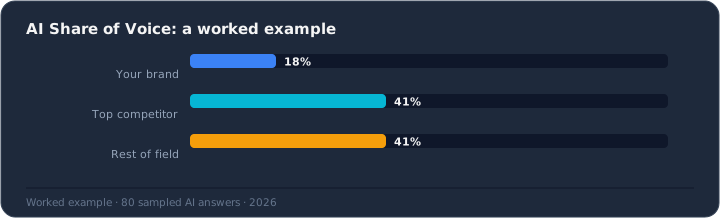
Worked example from 80 sampled AI answers: 14 named the brand (17.5% Brand Visibility, 18.4% Share of Voice). Method is the $0 protocol below.
How to measure AI visibility for $0: the prompt-sampling protocol
Prompt sampling is the whole method. Write 20 prompts your buyers would ask, 15 of them unbranded. Run each across four engines in clean sessions. Log every brand named, its position, and the cited domains. Compute the three metrics. Re-run the same set monthly. Cost: $0. Time: one afternoon.
Step 1 — Write 20 prompts, 15 of them unbranded
Unbranded category prompts are the ones that find new customers. Think "best [category] for [use case]", "how do I solve [problem]", "compare [approach A] and [approach B]". Branded prompts ("is [your brand] legit?") only tell you what people already checking on you see.
Even Profound, whose product starts at enterprise pricing, tells its own customers the same thing. Track "far more unbranded than branded prompts". Source the wording from reality, not guesses.
- Rewrite your Search Console queries as questions.
- Reuse the questions your sales and support calls open with.
- Mine the People Also Ask block on your money SERPs.
On this page's own SERP, PAA carries "How do I check my AI visibility?" — real searchers already phrase the job for you.
Step 2 — Run each prompt in four engines, in clean sessions
ChatGPT, Perplexity, Gemini, and Google AI Overviews are the four surfaces where US buyers ask category questions. Add Copilot if you sell into Microsoft-shop enterprises. Use a signed-out window or a fresh chat with memory off. An engine that knows you're the founder answers one way. It answers a stranger another.
Date every run. Answers move when platforms silently update models. An undated log can't separate your progress from their drift.
Step 3 — Log six columns per answer
- Date.
- Engine.
- Prompt.
- Your brand named, yes or no.
- Your position among the brands named.
- Competitors named plus domains cited.
That's 80 rows for the full 20 × 4 pass. Budget two to three minutes per prompt: run it, skim it, log it. The full pass takes 3–4 hours. Add a sentiment column if your brand does get mentioned. "Named as a leader" and "named in a complaint" are both mentions.
The five-step, $0 prompt-sampling protocol. One full 20x4 pass is 80 logged answers, about 3-4 hours.
One full 20x4 pass is 80 logged answers, about 3–4 hours.
Step 4 — Compute the three metrics
A worked pass, with the arithmetic visible. Say your 80 answers name you in 14. Brand Visibility = 14 ÷ 80 = 17.5%. Across the same answers, competitors collect 62 mentions. AI Share of Voice = 14 ÷ (14 + 62) = 18.4%. Eleven list-style answers include you. Your slots average 3.1. That is your average mention position.
The black box now has three numbers, a date, and a competitor baseline. That is more data than most brands asking "are we in ChatGPT?" have ever run.
Step 5 — Re-run the same set every month
Same prompts, same engines, same logging. One reading is a photograph. The trend starts at reading two. Changing prompts between passes kills the comparison. A "visibility jump" after a prompt rewrite measures your rewording, not your brand. New prompts go in as a labeled second set, never as replacements.
Know what the small sample can and cannot do. Profound's Prompt Volumes are built on 1.5B+ real user prompts . They break down by intent and demographics. Your 80 answers can't tell you demand volume, audience splits, or daily movement. They answer the one question that costs money to leave open: are you in the answer at all?
You outgrow the spreadsheet at daily cadence, rival dashboards, and citation tracking at scale. That's what the tested tool roundup is for. If even one afternoon is too much, our free checker runs the first pass for you.
What does good AI visibility look like?
There is no public industry benchmark for AI visibility. Among the 97 results on this query's SERP, I found no published distribution of visibility scores by industry. Practical benchmarks are structural.
0% on unbranded prompts means invisible. Parity with your top competitor's share of voice is the working target. Above 50% share of voice makes you the category default.
The most common first reading is zero. Zero is also the most telling number here. The r/SaaS founder above had solid Google rankings and months of content and backlink spend — and a 0% reading on the buying question that mattered.
Zero converts anxiety into a to-do list. It names the engines, the prompts, and the rivals that hold the ground you assumed was contested.
Structure caps everyone's numbers. That is why rank-tracking intuitions mislead here. An AI answer names a handful of brands. It cites 2–7 domains per response, per Profound's published average. If category answers typically name five brands and eight real rivals exist, someone is absent from every single answer.
Absence from one answer is weather. Absence from more than half your unbranded sample, while three or more competitors recur — that's a deficit with a cause.
From the audit practice, the working bands I use. They are labeled heuristics, not industry norms. The data to publish them doesn't publicly exist.
- 0% on unbranded prompts: invisible, the typical starting reading for SMBs and young SaaS.
- 1–15%: fringe, named occasionally and rarely first.
- Competitor parity: the first target worth defending budget for.
- Above 50% AI Share of Voice: the category's default answer — defend, don't chase.
Respect the noise floor when you grade yourself. The only published cadence experiment in this niche (next section) found once-a-day readings land within about 2 percentage points of ten-a-day readings. A move from 12% to 13.5% on an 80-answer manual sample is weather, not progress. Trend across three monthly readings before claiming victory or crisis.
Competitive benchmarking is the only honest yardstick between brands. Your absolute percentage depends on how the prompt set was built. Profound's own conclusion from its measurement study: "which prompts you track matters more than how often you run them".
Compare against rivals on the same prompts. Compare against yourself over time. Never compare your 17% to a number computed on someone else's prompt set.
How often should you re-check AI visibility?
Measurement cadence, short version: manual sampling monthly, with the same prompt set, plus a re-run within a week of a major model release. Tool-based tracking: daily. Running prompts more often than daily buys almost nothing. The numbers move mostly because the platforms themselves move.
The claim has an experiment behind it — the only published cadence experiment I found in this niche. In 2026, Profound ran the same 753 prompts across 7 platforms for two weeks. The platforms: ChatGPT, Gemini, Perplexity, Copilot, DeepSeek, Google AI Mode, AI Overviews. Two parallel setups: once a day versus ten times a day.
Roughly 129,000 runs against 860,000. The once-a-day visibility reading landed "within about 2 percentage points" of the 10×-a-day reading. Running ten times improved precision by only about 10%. Citation share was the one metric where extra runs helped — ten daily runs cut its day-to-day noise by roughly 40%.
The deeper finding is the ceiling. Platforms silently update models, tools, and systems. That drift sets a precision floor. No amount of same-day re-runs beats it. Their phrasing: "You can't measure your way past drift".
For a manual protocol the same logic scales down. Your 80-answer pass carries more sampling noise than a vendor's 753-prompt daily portfolio. So weekly manual re-runs mostly re-measure noise. Monthly is the floor that catches real movement. The full cadence map:
| Situation | Cadence | Why |
|---|---|---|
| Before any GEO spend. | One baseline pass. | Budget decisions need a number, not a feeling. |
| Steady state, no active campaign. | Monthly, same prompt set. | Trend beats precision at manual scale. |
| Active campaign: roundup outreach, review push, content sprint. | Every 2 weeks. | One third-party inclusion can flip mentions within weeks. |
| Major model or engine release. | Within a week of launch. | Platform drift moves readings most, per the 753-prompt experiment. |
| Paying for a tracking tool. | Daily. | Within ~2pp of 10×-a-day; intra-day sampling adds ~10% precision. |
One rule outranks every cadence rule: prompt-set stability. A stable, honestly built 20-prompt set re-run monthly beats a brilliant new prompt set every week. Only the first one can show a trend.
How do you improve AI visibility once you've measured it?
Two lever groups. Off-site: get into the third-party roundups, review platforms, and comparison pages that engines retrieve. That most often moves unbranded prompts. On-site: answer-first formatting, consistent entity facts, citable statistics . That moves citations of your own domain. Your deficit pattern tells you which group is yours.
The log you built in Step 3 is the diagnosis. Named but never cited: a content problem. Your pages aren't the extractable source, so fix structure and citable specifics on-site. Never named at all on recommendation prompts: a source problem. The engines' retrieval pool — review platforms, "best X" roundups, category comparisons — doesn't contain you.
No amount of on-site polish fixes an off-site absence. Named with wrong facts, old pricing, dead features: an entity-consistency problem across the pages engines keep retrieving.
The off-site lever has the strongest logged case in the niche. In June 2026 an agency operator posted the pattern on r/MarketingandAI . Two months of schema, llms.txt , and FAQ rewrites for a B2B client: "Genuinely zero change".
Then the client started appearing in ChatGPT answers by name — because "some 'best [x] companies' roundup had added him a couple weeks before. That was it. That was the whole thing". One third-party inclusion beat the entire on-site checklist. Weight your effort accordingly. Distrust any playbook that only sells you on-site work.
Per-engine tactics differ enough to deserve their own pages. Start with the ChatGPT visibility playbook if that's where your buyers ask. Once the spreadsheet stops scaling, move up. The AI visibility tools roundup and GEO tools comparison carry the rankings this page deliberately doesn't.
The shortest path from reading to plan: run the free checker for a baseline. A full GEO audit then turns your deficit pattern into a ranked fix list.
No comments yet