
Answer engine optimization (AEO) is the practice of structuring content so answer engines can extract, attribute, and reuse it. Answer engines include featured snippets, People Also Ask, voice assistants, and AI answers in ChatGPT, Perplexity, and Google AI Overviews.
The working unit is a 40–60-word direct answer under a question-phrased heading, backed by FAQ schema and dated sources.
Across the 49 Google SERPs captured for this project's research corpus, exactly one carries a classic featured snippet. The query is "what is aeo" — 3,600 searches a month, snapshotted July 9, 2026. Coursera holds it with a 26-word definition.
It names no engine, no surface, and no method. The head term "answer engine optimization" (2,400 searches a month) gets no snippet at all. Google answers it with an AI Overview built from 12 sources. Same discipline, two queries, two different answer machines.
- AEO structures content so answer engines can extract, attribute, and reuse it.
- Two pipelines: extraction lifts your 40–60-word block verbatim; synthesis writes a new answer citing sources.
- Only 38% of cited pages sat in the organic top-10 (Ahrefs, February 2026).
- 95% of ChatGPT citations come from content published or updated within the last 10 months.
- A visible "last updated" timestamp earns 1.8× more citations.
That asymmetry is the whole subject. One query gets its answer extracted from a ranked page. The other gets its answer written by a model that cites sources. AEO is the practice of winning both. A page that teaches answer extraction should also demonstrate it. So this one is built as its own test case.
- A 58-word definition up top.
- A 40–60-word answer under every heading.
- An FAQ built from Google's actual People Also Ask questions.
- Article, FAQPage, and DefinedTerm schema underneath.
The receipts: two full SERP snapshots (Google US, July 9, 2026), the incumbents' published guides, and the studies they cite.
What is answer engine optimization?
AEO makes your content the answer an engine shows — not just a link it ranks. Two mechanics do the work. Extraction: a snippet, People Also Ask slot, or voice assistant lifts your 40–60-word block verbatim. Citation: an AI answer names or links you as a source. Vendors define AEO differently; the mechanics stay constant.
The question outsearches the term it asks about. "What is aeo" pulls 3,600 monthly US searches. The full phrase "answer engine optimization" pulls 2,400. Google treats the two as one intent.
Four URLs sit in both captured top-10s: Coursera, HubSpot, Profound, and one Ahrefs course video. So this page carries both queries instead of splitting into a pillar and a separate definition post.
The term is older than the AI it now serves. Wolfram|Alpha launched in May 2009, and the press called it an "answer engine". The noun predates ChatGPT by 13 years. Google's featured snippets arrived in 2014 and gave the practice its first real surface: win the extraction, get the box above position one. Voice search stacked a third surface on top.
Alexa and Google Assistant read one answer aloud, so the extraction pool became the only pool. Then the 2022–2024 wave of ChatGPT, Perplexity, and AI Overviews added a second species of answer engine. This one writes rather than lifts. The full genealogy, and the boundary dispute with GEO, is documented in AEO vs GEO .
The stakes are the clicks that no longer happen. When the answer appears in the box or the Overview, the visit becomes optional. Zero-click results replace the blue-link visit.
The erosion shows up in Search Console as rising impressions against flat clicks. AEO is the constructive response. If attention settles in the answer layer, put your content in the answer layer.
"Answer engine" is a broader category than most guides admit, and the surfaces don't behave alike:
| Answer engine | How it answers | Where the answer shows |
|---|---|---|
| Google featured snippets. | Extraction — one block lifted from one ranked page, linked. | Top of the classic SERP. |
| People Also Ask. | Extraction — one block per question, expandable. | Mid-SERP question accordion. |
| Voice assistants: Siri, Alexa, Google Assistant. | Extraction — a single answer read aloud. | Voice, no screen required. |
| Google AI Overviews and AI Mode. | Synthesis — a written answer citing multiple sources. | Above or instead of results. |
| ChatGPT with search, Perplexity, Gemini, Copilot. | Synthesis — a chat answer with citations or named brands. | Chat interface. |
The middle column is the split that organizes every tactic on this page. Extraction preserves your words and credits your page. Synthesis rewrites them — and decides, source by source, whether you get named at all.
Two dialects of the same acronym
Because the surfaces multiplied, the definitions split. Semrush's guide runs 2,420 words and ranks #22 on the head term. It defines AEO as "a set of marketing practices used to increase your brand's visibility in AI-generated answers." Profound's runs 2,999 words and sits in both captured top-10s.
Its definition: structuring content so AI tools "can easily understand, trust, and cite it as direct answers to user queries." Seobility's wiki entry — the #6 result on "what is aeo" — keeps the older, narrower meaning: content "easily discoverable by answer engines."
HubSpot splits the difference. Its guide sits #6 on the head term and #2 on "what is aeo". It talks about improving "how often and how accurately your business appears in AI-generated answers." Frequency plus accuracy: the practical middle ground.
Three ranking definitions, two dialects. The classic dialect grew out of snippet optimization and voice search: map known questions, answer them in extractable blocks, win the box. The 2026 vendor dialect stretches AEO to cover AI-generated answers wholesale.
That's the territory the GEO camp claims under its own name. Neither dialect is wrong. They encode different histories. Forcing one on a reader who speaks the other just loses the reader.
This page uses the mechanics-first reading. AEO is answer-block engineering for every surface that shows direct answers: featured snippets, People Also Ask, voice assistants, AI Overviews, chat engines.
The off-site, entity-level work of getting your brand recommended inside AI responses at large belongs to generative engine optimization . Where a tactic below crosses that border, it's labeled.
AEO is not American Eagle: three homonyms to rule out
Answer engine optimization shares its acronym with three unrelated entities. American Eagle Outfitters — the NYSE ticker is AEO. Authorized Economic Operator — a customs status. Apraxia of eyelid opening — a medical condition.
Marketing AEO is unrelated to all three. Two of the four People Also Ask questions on "what is aeo" belong to the homonyms, not the discipline.
The pollution is visible in Google's own question set. The PAA block on "what is aeo" asks four questions, in this order.
- "What does AEO stand for in medical terms?"
- "Is AEO a real thing?"
- "What is AEO in American Eagle?"
- "What is an AEO agency?"
Half of it is homonym traffic. None of the 59 captured results sorts this out. The slot is open. If you searched one of the other AEOs, here's the sorting:
| The acronym | Field | What it means | Related to answer engine optimization? |
|---|---|---|---|
| AEO — American Eagle Outfitters. | Retail, stock market. | The apparel retailer. Its stock trades on the NYSE under the ticker AEO. | No. |
| AEO — Authorized Economic Operator. | Customs, trade. | A supply-chain security status. National customs authorities grant it under the World Customs Organization's SAFE Framework. | No. |
| AEO — apraxia of eyelid opening. | Medicine. | A neuro-ophthalmic condition: difficulty starting voluntary eyelid opening. | No. |
| AEO — answer engine optimization. | Marketing. | The subject of this page: making content extractable and citable by answer engines. | — |
This block is a demonstration, not a digression. A model resolving "what is aeo" has to decide which AEO you mean before it can answer. An explicit not-list is the cheapest entity clarity an on-page team can ship. This page also declares the term in DefinedTerm schema — the machine-readable version of the same statement.
The not-list is extraction bait, too: a self-contained "X is not Y, Z, or W" block is precisely the shape People Also Ask rewards. Maybe your own brand shares a name with a retailer, a customs regime, or a medical condition. Write the not-list before a model writes it for you.
How do answer engines pick answers?
Answer engines run two selection pipelines. Extraction surfaces — featured snippets, People Also Ask, voice search — lift one block from one ranked page.
Synthesis surfaces — AI Overviews, ChatGPT, Perplexity — fan a question out into sub-queries, retrieve sources, and write a new answer that cites a few domains. A page can win one pipeline and lose the other.
Extraction: the snippet, People Also Ask, and voice
On "what is aeo", Google extracted Coursera's answer. It's a 26-word definition dated December 9, 2025: "Answer engine optimization (AEO) helps your brand stand out on AI-powered platforms by making your content more likely to appear as a response to user questions." Competent, sized for the box, and vague.
No named engine, no surface, no method. It won anyway — because it's a self-contained block directly under a heading that repeats the question. That's the entire extraction contract. Note the date shown next to the snippet, too. Google displays it, which means Google reads it.
One more behavior matters for planning. Boxes are sticky. The holder tends to keep the slot until the content in the pool changes, not just the order of the links. So treat a target box as a content problem: ship a better block, wait for the recrawl, measure again.
The competition for that box is dense and uniform. 38 of the 59 captured titles — 64% — ask "what is" some variant of the term. Among the text pages, almost everyone answers in the first paragraph.
One got lifted. Extraction is a winner-take-one game. The surface shows a single answer. Voice search sharpens the stakes further: an assistant reads exactly one result aloud. The rest of the SERP doesn't exist.
The same snapshot documents where the losing text pages went. Nowhere. 27 of the 59 captured results — 46% — are YouTube videos, most of them two-minute "What is AEO?" explainers. Video is not a side channel here; it's how nearly half the SERP answers a what-is question.
Profound's citation data says the engines agree. Social platforms account for 15.3% of AI Overview citations and 14.5% in AI Mode. In English-language AI Overviews in Australia and the UK, YouTube alone is cited 38% of the time. A text-only AEO program concedes half the answer inventory before it starts.
People Also Ask is the same mechanism with a longer tail. Each PAA question is its own extraction slot. It gets filled from a page that answers that exact question in a liftable block. A pillar that answers eight mapped questions in eight answer capsules competes for eight boxes, not one.
That's why question-based queries — not head keywords — are the planning unit of AEO. The two SERPs behind this page make the point in miniature: their PAA sets share zero questions. Eight distinct slots across one pair of near-synonymous queries, each slot with its own winner.
Synthesis: AI Overviews and chat engines
The head term shows the second pipeline at work. The AI Overview on "answer engine optimization" synthesizes 12 sources. The first one listed is not Forbes (#2 in the captured organic results) and not HubSpot (#6).
It's a Reddit thread from r/localseo titled "What is AEO?" — which also ranks #4 organically. Four of the 12 sources are YouTube videos. The definitive answer about answer engine optimization, on Google, opens with a forum post. It leans on video. Not on any vendor's 3,000-word guide.
The Overview even instructs while it answers. The advice is credited to Forbes. Answer the core question "in the first 40–60 words, followed by detailed bullet points or short, self-contained paragraphs."
Google's synthesized answer about AEO recommends the exact block format this page uses. When the surface tells you its preferences in its own words, believe it.
Synthesis runs on retrieval, and retrieval doesn't mirror rankings. Ahrefs checked 4 million AI Overview URLs in February 2026. Only 38% of cited pages sat in the organic top-10 for the same query. Seven months earlier the figure was 76%.
Another 14.4% came from pages outside the top 100. And this is the default surface now, not an edge case. In our wider 49-snapshot corpus, AI Overviews sat on 34 of the 40 US SERPs we checked for features — 85%.
Before retrieval, the engine breaks the question apart. Nectiv analyzed roughly 60,000 Google fan-out queries . The average prompt fans out into about 9 sub-queries, and 24% of them run 12 to 19 words. Those long, conversational queries are what your content actually gets matched against. The mechanics live in the glossary under query fan-out .
Freshness gates the whole pool. AirOps found 95% of ChatGPT citations come from content published or updated within the last 10 months. Pages with a visible "last updated" timestamp earn 1.8× more citations than pages without one.
Nectiv's fan-out data shows why: the year is frequently written into the sub-query itself. A 2023 page never enters the candidate set.
Two pipelines feed AEO: extraction lifts an existing answer block; synthesis writes a new answer from retrieved sources.
Two pipelines feed AEO: extraction lifts an existing answer block; synthesis writes a new answer from retrieved sources. A page can win one and lose the other.
What both pipelines reward
The overlap is formatting and evidence. The GEO research paper (Aggarwal et al., November 2023, presented at KDD 2024) benchmarked tactics on generative engines. Adding statistics, quotations, and citations raised source visibility by up to 40% across queries. Keyword stuffing moved nothing.
Hands-on testers land in the same place. A tester on r/ChatGPT summed up his findings on February 17, 2026: "ChatGPT seems to prefer clear, definition-first content… Pages with direct answers at the top are easier to extract. Structured sections and self-contained paragraphs matter a lot."
The failure mode is the mirror image, and it's the most common complaint in the niche.
From r/SEO_LLM, July 8, 2026 : "It's well researched, answers the query, reads well, and sometimes even ranks decently in Google. Yet it rarely seems to appear in AI-generated answers." Quality prose is not the unit of selection. The extractable block is.
What does your existing SEO already cover?
Your SEO covers the substrate. 99% of AI Mode URLs sit in the top 20 organic results (Bounteous, July 2025). What SEO does not cover: answer formatting, question mapping, off-site review presence, citation measurement. That gap is real work. It is not a new discipline, whatever the pitch deck says.
The pressure to answer this precisely comes from dashboards, not vendors. A product builder said it plainly on r/AISEOTricks , April 2026: "after looking google search console, it's clear that CTR is dropped in general (like the way it used to be), so next step is optimizing for ANSWER ENGINES?"
The skepticism arrives in the same inbox. "Do brands really need 'Answer Engine Optimization' or is it just rebranded SEO?" That exact question ran on r/AISEOExplained in December 2025.
An in-house marketer put the budget version on record. r/content_marketing , August 2025: "we're struggling to see how it differs from normal SEO… And all the Linkedin corporate fluff about saying it's a totally new discipline." The honest answer is a ledger, not a slogan. Asset by asset — what transfers, what's missing:
| SEO asset you already have | What it already buys you in AEO | What it doesn't cover |
|---|---|---|
| Crawlable, indexed site. | Everything downstream. 99% of AI Mode URLs sit in the organic top 20. A blocked crawler is an invisible answer. | Nothing. This transfers whole. |
| Organic rankings. | A seat near the extraction pool. Featured snippets are lifted from ranked pages. | AI Overview citations. Only 38% come from the organic top-10; 14.4% come from beyond the top 100. Rank helps. It no longer decides. |
| Backlink profile. | Rankings, crawl access, and on-page relevance still correlate with citation odds, per Zyppy's aggregation of 50+ citation-factor studies . | Presence in the specific sources engines re-read: review platforms, category roundups, community threads. |
| Keyword research. | The demand map and the topic clusters. | Question mapping. Prompts fan out into ~9 sub-queries, many 12–19 words long — shapes no keyword list contains. |
| Schema markup. | A ticket to Google's extraction surfaces: snippets, PAA, rich results. | LLM crawlers. A 6-engine test on r/TechSEO (April 2026) planted 60+ coded markers in a page. Meta descriptions, JSON-LD, OG tags, and schema scored zero reads. "The only metadata any of them read was the title tag." |
| Freshness discipline. | Transfers and gets amplified. 95% of ChatGPT citations are under 10 months old. | Nothing missing except honesty about cadence. |
| Search Console habit. | Impressions now include AI Overview appearances. Zero-click results leave a visible trace. | Prompt sampling. No Google tool shows whether ChatGPT or Perplexity mentions you. |
Read the two right-hand columns and the "rebranded SEO" fight resolves itself. The substrate is SEO. The answer layer is new work on top of it.
What this page deliberately does not do is score the two disciplines against each other, practice by practice. That comparison — with effort and impact ratings for each shared tactic — lives at AEO vs SEO .
The schema row deserves one more sentence, because every incumbent guide says "add structured data" and stops. Structured data is worth shipping. It powers the extraction surfaces, where Google's own index does the reading.
It is not a signal to chat engines: their crawlers convert your page to plain text and throw the <head> away before the model sees anything. FAQ schema wins you PAA eligibility. It does not make ChatGPT cite you. Budget accordingly.
The AEO checklist: eight moves in order
Eight moves, in order. Map real questions from People Also Ask and fan-out data. Answer each in a 40–60-word capsule under a question-phrased heading. Keep paragraphs atomic. Add FAQ schema. Date and refresh pages. Keep entity facts consistent everywhere. Earn off-site reviews and roundup listings. Track extractions and citations monthly.
| # | Move | Spec |
|---|---|---|
| 1 | Map the questions. | Pull the PAA set for every target query, plus the fan-out sub-queries behind it. These queries run long — 24% of fan-out queries are 12–19 words. Map questions, not keywords. |
| 2 | Answer first. | A 40–60-word answer capsule directly under the H1 and under every major H2. Direct answers before context, always. |
| 3 | Phrase headings as questions. | Match the PAA phrasing users actually see. "How do you measure AEO wins?" extracts. "Measurement considerations" doesn't. |
| 4 | Keep paragraphs atomic. | 1–3 sentences. One idea. Self-contained enough to survive being lifted without its neighbors. |
| 5 | Ship the schema. | Article plus FAQPage. HowTo where steps exist. DefinedTerm on definitions. This buys you the Google surfaces — see the caveat above about what LLM crawlers actually read. |
| 6 | Date everything. | Visible "updated" timestamp (1.8× citation rate). |
| 7 | Fix your entity facts. | Consistent name, description, and claims across your site, review platforms, and directories. A Seer Interactive study of 800,000+ AI answers found review sites among AI's strongest trust signals. It also found a negative review from 2018 still being repeated in 2026. This step crosses into GEO territory. It's here because answer surfaces read it. |
| 8 | Track monthly. | Snippet and PAA share on mapped questions. AI Overview citation share. Prompt samples across engines. Untracked AEO is a faith-based program. |
Steps 1–6 are page work an existing content team can execute this quarter. Steps 7–8 are where AEO stops being a formatting exercise. No capsule format compensates for an entity the engines don't trust. And no effort survives contact with a CMO without step 8's numbers.
Maybe you own one afternoon, not a quarter. Then run the loop small.
- Pick five questions your buyers ask.
- Rewrite one page capsule-first.
- Add the FAQ block and the date stamp.
- Sample ten prompts and write down who gets named.
That's a complete AEO cycle — small enough to finish, honest enough to judge.
Worked example: mapping the questions (step 1, on this page)
The two queries this page targets carry eight People Also Ask questions between them. Two belong to homonyms. They became the homonym table above — answering the American Eagle question earnestly would be intent theft against a clothing shopper. The remaining six became the FAQ below, phrased word for word.
Two are definitional. One is the vs-SEO question. Two ask about tools and agencies. One asks whether AEO is real at all. One page, one snippet target, six PAA targets. That's the whole mapping exercise. It costs about an hour per cluster, and it dictates the outline instead of decorating it.
Worked example: writing the capsule (step 2, against the incumbent)
The box this page targets is held by a 26-word definition whose only verbs are "helps", "stand out", and "appear". No engine named. No unit of work. No mechanism. The rewrite discipline runs in four moves. Name the surfaces: snippets, People Also Ask, voice, AI answers. Name the engines: ChatGPT, Perplexity, AI Overviews.
Name the unit: the 40–60-word block. Stay inside the box's word budget. That produces the 58-word definition at the top of this page. Extraction surfaces are sticky — Coursera may hold the box for months. But a materially more specific block under the same question is the only displacement strategy with mechanics behind it rather than hope.
The anatomy of a capsule that survives extraction: a subject–verb–object first sentence that could stand alone in the box. A number or a named entity in the first two lines.
No pronoun that points outside the block, and no "as mentioned above". One test covers it all — if a voice assistant read the block aloud with zero context and it still made sense, it ships.
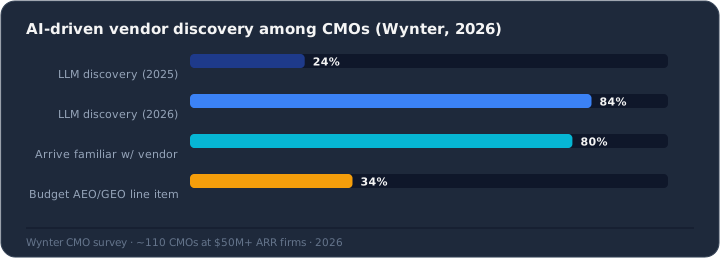
Wynter surveyed ~110 CMOs at $50M+ ARR firms in 2026. LLM use for vendor discovery rose 3.5x year over year.
How do you measure AEO wins?
Count answers, not positions. Four numbers monthly. Featured-snippet and People Also Ask share on mapped questions. AI Overview citation share. Impressions-without-clicks in Search Console. Brand mentions in sampled prompts across ChatGPT, Perplexity, and Gemini. AI-referred visitors convert 4.4× better than organic search visitors (Semrush, 2025) — measure them like they matter.
The stakes moved faster than most dashboards. Wynter surveyed roughly 110 CMOs at $50M+ ARR companies in 2026. 84% now use LLMs for vendor discovery — up from 24% in 2025, a 3.5× jump in twelve months. 80% arrive at sales calls already familiar with the vendor.
34% budget GEO or AEO software as a distinct line item. The consumer side is moving too. McKinsey projects around $750 billion in consumer spend flowing through AI-powered search by 2028. 71% of users already start their purchase journey there. The buyers moved. The metrics have to follow them.
The four numbers split cleanly across the two pipelines. Each has a home and a cadence:
| Metric | Where you read it | Cadence | A win looks like |
|---|---|---|---|
| Featured-snippet and PAA share. | Any rank tracker that flags SERP features, on your mapped question list. | Weekly. | Boxes held or gained on mapped questions. |
| AI Overview citation share. | Manual checks or an AI-visibility tracker on core queries. | Monthly. | Your domain inside the Overview's source list. |
| Impressions without clicks. | Google Search Console, Performance report. | Monthly. | Rising impressions on answer-shaped queries. Countable zero-click results, not invisible losses. |
| Prompt-sample mentions. | A fixed prompt set asked across ChatGPT, Perplexity, Gemini. | Monthly, same prompts every time. | Named in a growing share of answers. |
Set the baseline before the first edit ships. Month zero: how many mapped questions show a box, who holds each one, whether the Overview cites you, and your prompt-sample mention rate. Every later number gets judged against that snapshot.
On timelines, Profound's guide reports early movement within weeks once pages are restructured with direct answers and schema. Treat that as the optimistic bound, not the promise. Extraction wins tend to land first — a recrawl is all they need. Citation wins in chat engines follow slower, on retrieval and model-refresh cycles.
Divide your prompt-sample mentions by mentions of you plus competitors, and you have AI share of voice . That's the single number that survives a budget meeting. Add one more free signal: branded search volume. Filter Search Console queries to your brand name and watch the trend, because answer-engine wins surface as brand demand before they surface anywhere else.
An agency operator on r/GEO__AI__SEO tracked B2B clients through February 2026. Traffic flat. Rankings stable. "But branded search volume started creeping up". Meanwhile the sales calls filled with the new phrases. "ChatGPT recommended you". "We saw you mentioned in an AI answer". "Claude listed you as one of the top tools".
One vocabulary note from that same sales floor, because the win means different things to different operators. Marketers get cited. SMB owners get recommended. Founders get mentioned. All three are the same measurable event: your name inside an answer you don't control.
If your reporting only counts positions, that entire pipeline is dark. A five-minute prompt sample turns the lights on — check your AI visibility before you commit budget to formatting work.
No comments yet