
AEO (answer engine optimization) optimizes individual answers for extraction — featured snippets, People Also Ask, AI quick answers. GEO (generative engine optimization) optimizes your brand's presence inside AI-synthesized responses in ChatGPT, Perplexity, and Google AI Overviews. Google itself treats them as separate topics: the two comparison SERPs shared zero top-10 URLs in July 2026.
Google returned 98 results for "aeo vs geo" on July 10, 2026. Exactly one argues the two terms mean the same thing. It sits at #4. It belongs to Profound , a vendor that sells AI-visibility tracking under the AEO label.
Among the other 97 sit 52 titles built around "difference" or "differ" — 53% of the captured set. Someone is wrong here. "Everyone except the vendor" is not automatically the right answer, though. So I pulled the data. Two full SERP snapshots, the vendor's own published pages, and the paper that coined one of the terms.
- AEO targets the answer box; GEO targets the answer itself.
- The two comparison SERPs shared zero top-10 URLs in July 2026.
- An AEO win still sends a click; a GEO win is often zero-click.
- AEO accreted from the snippet era; GEO was coined in a 2023 arXiv paper.
- On-page work converges, measurement diverges — budget follows the metric.
This page gives you working definitions and the documented history of both acronyms. Then a side-by-side table and a fact-check of the "same thing" claim. Then the three-way GEO vs AEO vs SEO comparison and a decision matrix by business type.
The short answer: different targets, overlapping methods
AEO targets the answer box. GEO targets the answer itself. In AEO you optimize one page to answer one known question. The win is a featured snippet, a People Also Ask slot, or a voice-assistant readout.
In GEO you optimize an entity: your brand plus every third-party source about it. The win is a citation when an AI engine writes a multi-source response from scratch.
The confusion is real and measurable. The #2 result for "aeo vs geo" is not an expert guide. It's a Reddit thread titled "Can someone explain GEO and AEO in a simple way?".
The author understands SEO well. These two acronyms still lost him. That thread outranks expert content from 78 distinct domains. When a plain question beats them all, the expert content isn't answering the question.
The practical split runs on three axes.
- Traffic vs visibility: an AEO win still sends a click, because the snippet links to you. A GEO win is often zero-click — your brand appears inside the generated text, and the click is optional .
- Intent match: AEO maps known questions to prepared answers. GEO covers open-ended prompts, which a model decomposes into 5–15 sub-queries via query fan-out .
- Measurement: AEO counts snippet wins on SERPs you can track. GEO samples prompts across engines and computes AI share of voice .
Boil the query-model gap down and it reads keyword targeting vs prompt coverage. Same content foundation, different scoreboard — and that's why the terms refuse to merge.
A paired example makes it concrete. Say you publish a pricing guide. The AEO outcome: Google lifts your 47-word definition into a snippet for "what does X cost". Search Console shows the clicks. The GEO outcome: a buyer asks ChatGPT to "compare the top X vendors for a 50-person team".
The model fans the prompt out. It retrieves a handful of sources. It names you, or it doesn't. The first outcome is visible in your analytics today. The second stays invisible until you sample the prompts yourself — the "black box" complaint that dominates every practitioner thread on this subject.
Where did AEO and GEO come from? The documented timeline
The two terms have opposite origin stories, and the asymmetry explains most of today's confusion. GEO has a birth certificate: an academic paper with a date, authors, and a benchmark. AEO has none. It accreted out of practice over roughly a decade, which is why every agency defines it slightly differently.
| Date | Event | Term it shaped |
|---|---|---|
| May 2009 | Wolfram|Alpha launches. Press calls it an "answer engine" — the noun predates LLMs by 13 years. | AEO |
| 2014 | Google rolls out featured snippets. Optimizing for extraction becomes a real practice with no agreed name. | AEO |
| 2016–2019 | "Answer engine optimization" circulates in the snippet and voice-assistant era (Alexa, Google Home). No paper, no single documented coiner. | AEO |
| Nov 30, 2022 | ChatGPT launches. Within months, brands notice AI assistants naming competitors. | both |
| Nov 16, 2023 | arXiv:2311.09735 coins "generative engine optimization" (Aggarwal et al. — Princeton, Georgia Tech, Allen Institute for AI, IIT Delhi). The paper ships the GEO-bench benchmark and reports visibility gains up to 40%. Presented at KDD 2024. | GEO |
| May 14, 2024 | Google launches AI Overviews in the US. Extraction and synthesis now collide on one surface. | both |
| Jun 29, 2025 | Profound publishes "AEO vs. GEO: Why they're the same thing" — the lumper camp's flagship. | the fight |
| Oct 27, 2025 | Digiday runs "WTF are GEO and AEO?" . Trade press documents that the industry can't agree. | the fight |
| Jul 10, 2026 | Google serves non-overlapping top-10s for "aeo vs geo" and "aeo vs seo" (my snapshot, below). | the split |
The two acronyms have opposite origins: AEO accreted from the snippet era; GEO was coined in a 2023 arXiv paper.
Sources: Wolfram|Alpha 2009; Google snippets 2014, AI Overviews 2024; arXiv:2311.09735; Profound Jun 2025; Digiday Oct 2025.
The genealogy matters because each term carries its origin's DNA. AEO inherited the snippet era's toolkit. Question mapping, concise structured answers, FAQ and HowTo schema, the 40–60-word answer capsule . GEO inherited the paper's framing. That means citations inside generated text, plus source-level visibility metrics.
The researchers benchmarked actual tactics, too. Adding statistics, quotations, and citations raised visibility in their tests. Keyword stuffing didn't. Nobody who says "AEO" means "run GEO-bench evals". Nobody who says "GEO" means "win the Alexa readout". The dialects encode different histories, not different egos.
One disambiguation before this table gets quoted out of context. GEO here has nothing to do with geotargeting, local SEO, or geographic anything. The collision is real: in our July 2026 SERP corpus, service-flavored "geo" queries returned construction firms and a private-prison operator.
Zero marketing results. This page uses GEO strictly as the arXiv paper defined it — generative engine optimization .
A third dialect deserves a footnote. LLMO (large language model optimization) shows up in practitioner threads as a synonym for GEO. Neil Patel ranks on this very SERP asking "AEO vs GEO vs LLMO: Are They All SEO?".
The naming chaos is a documented feature of this niche. Forcing one canonical term on readers just loses the ones who arrived speaking the other dialect.
AEO vs GEO side by side
The disciplines diverge on target, query model, metric, and payoff. They converge on almost everything you'd do to a single page. Eight dimensions, compared:
| Dimension | AEO | GEO |
|---|---|---|
| What you optimize | One page answering one known question. | An entity's footprint across everything AI engines retrieve. |
| Primary surfaces | Featured snippets, People Also Ask, voice assistants, AI quick answers. | ChatGPT, Perplexity, Gemini, Google AI Overviews and AI Mode. |
| Unit of work | The extractable answer block (40–60 words). | The citation: your domain named inside a generated response. |
| Query model | Keyword targeting — a finite list of mapped questions. | Prompt coverage — open prompts fanned out into 5–15 sub-queries. |
| Ranking factors vs citation factors | Position and extractability on a SERP you can see. | Retrieval and synthesis: making the 2–7 domains an LLM cites per response (Profound's published average). |
| Success metric | Snippet and answer-box wins for target questions. | Citation frequency, AI share of voice, average mention position. |
| Payoff model | Traffic — the snippet still links out. | Visibility — the mention converts even without the click. |
| Term origin | Practice-born, snippet era, no single coiner. | Coined in arXiv:2311.09735, November 2023. |
The verdict this table supports: on-page work converges, measurement diverges. A clear capsule under a question-phrased heading serves both disciplines at once. What you count afterward splits them completely. A dashboard tracking snippet positions on known queries is doing AEO.
A dashboard sampling category prompts across four engines and computing mention share is doing GEO. Budget follows the metric. That's why the distinction survives every attempt to merge it.
The org chart splits the same way. AEO lives naturally inside an existing content or SEO team. It's question research plus formatting discipline, executed on pages you own. GEO spills into PR and partnerships the moment you touch its highest-leverage inputs.
Those are third-party roundups, review platforms, entity mentions on sites you don't control. A team can be excellent at one and structurally unable to do the other. That's a second reason the labels resist merging — they name different budget owners, not just different tactics.
"AEO and GEO are the same thing" — checking Profound's claim
Profound's claim is the strongest version of the lumper argument. It comes from a company with real data. It deserves a real check, not a dismissal. On June 29, 2025 they published "AEO vs. GEO: Why they're the same thing". It ranked #4 for "aeo vs geo" as of July 10, 2026.
Their 2025 GEO guide says it plainly. Quote: "At Profound, we still prefer the term AEO (Answer Engine Optimization) vs GEO but right now the discourse is split between these two terms".
The steelman first, because the claim is half right. Both terms describe optimizing for AI-mediated answers instead of ranked links. The tactical overlap on a single page is near-total: structured answers, schema, credible sourcing, extractable statistics. Ahrefs argues an even broader version. "GEO, LLMO, AEO… It's All Just SEO" ranks #29 on this same SERP.
For a team deciding what to do this quarter, label wars genuinely waste budget. Profound also has receipts. They report their AEO guide has been cited over 9,000 times across the LLMs they track. Whatever they call the discipline, they practice it well.
There's also a reader for whom Profound's framing is the useful one: a buyer choosing a tracking tool. Every serious AI-visibility platform measures the same events, whether its marketing says AEO, GEO, or LLMO. It samples prompts, counts brand mentions, and logs cited sources.
Evaluating dashboards? Ignore the acronym on the pricing page. Compare prompt coverage, engine coverage, and sampling cadence instead. The label matters when you allocate strategy budget, not when you compare feature lists.
Now the tests the claim fails.
Test 1 — the mechanism. AEO optimizes for extraction. An engine lifts your existing answer block and displays it, attribution attached. GEO optimizes for synthesis. An engine reads 2–7 sources and writes a new text. Then it decides whether your brand appears in it.
A page can hold a featured snippet for years and never be named in a ChatGPT category answer. The retrieval pipelines differ, the competition set differs, and the failure modes differ. Two optimization targets that succeed and fail independently are not one discipline.
Test 2 — the search market. If the labels were interchangeable, Google would serve near-identical results for their comparison queries. It doesn't. Across the captured top-10s of "aeo vs geo" and "aeo vs seo," zero URLs appear on both. The only shared presences are reddit.com and youtube.com as domains — different threads, different videos.
Full-depth overlap: 8 URLs out of the 98 captured per query, or 8%. HubSpot maintains two separate articles, each ranking on its own query. The aeo-vs-geo piece sits at #14 for "aeo vs geo". The aeo-vs-seo piece sits at #10 for "aeo vs seo".
Writesonic says it has analyzed over 1 million AI-generated answers . It still maintains three separate comparison pages, one per pair. The publishers with the most data treat the terms as distinct topics, because the search demand is distinct.
Test 3 — the engines themselves. The AI Overview on "aeo vs geo" opens with a verdict: AEO and GEO, it says, are "distinct AI search strategies". It cites 14 sources. Profound's "same thing" article is one of them.
Google's generative engine read the strongest published argument for merging the terms — and synthesized the opposite conclusion. That's a GEO outcome, incidentally: being cited inside an answer you don't control.
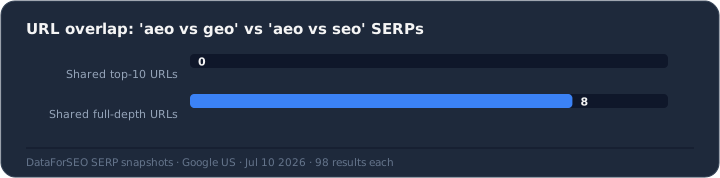
Two Google SERP data snapshots, Google US, July 10 2026, 98 results each. Zero top-10 overlap; 8 of 98 shared at full depth.
The verdict. Profound is right that the toolbox overlaps and that label wars burn budget. The stronger claim — that the terms collapse into one — fails twice and gets contradicted once. It fails on mechanism. It fails on measurable search intent. And the very AI Overview that cites it says the opposite.
Their own pages suggest a simpler explanation. Profound picked AEO as brand vocabulary early ("we still prefer the term"). The market's usage split. "They're the same thing" is the position that protects an existing content investment. That's a rational business choice, documented honestly in their own guide. It just isn't a fact about the terms.
GEO vs AEO vs SEO: the three-way comparison
Add SEO to the frame and the relationship becomes layers, not rivals. SEO is the substrate: if crawlers can't index you, neither discipline above it functions. AEO and GEO fork at the top — extraction vs synthesis.
| SEO | AEO | GEO | |
|---|---|---|---|
| Goal | Organic rankings and clicks. | Be the extracted answer. | Get cited and recommended inside AI answers. |
| Where you win | The 10 blue links. | Snippets, PAA, voice readouts. | ChatGPT, Perplexity, Gemini, AI Overviews. |
| Query model | Keywords with search volume. | Known questions, mapped one-to-one. | Open prompts, decomposed by query fan-out. |
| Core levers | Crawlability, content, backlinks. | Question-phrased headings, answer capsules, FAQ schema. | Entity consistency, third-party mentions, citable statistics. |
| Primary metric | Positions and organic traffic. | Snippet and answer-box share. | Citation frequency, AI share of voice. |
| Relationship | The foundation both sit on. | Search engine optimization extended to extraction surfaces. | Consumes SEO's index. Extends off-site into sources you don't own. |
Two facts anchor the verdict. First, the "aeo vs geo" SERP carried no featured snippet and zero ads in my July 2026 snapshot. It did carry an AI Overview and a full People Also Ask block. Across our wider corpus, AI Overviews sat on 30 of 34 US niche SERPs — 88%.
The extraction and synthesis surfaces are live on the exact queries where the disciplines get debated. The classic real estate sits empty. Second, these are complementary strategies in the most literal sense. The same answer capsule that wins a PAA slot is the fragment an LLM lifts into a synthesized response.
A hybrid search strategy isn't a compromise between three options. It's the only setup where each layer feeds the next. That's the future of search as it already runs on one results page: ranked links, extracted answers, generated summaries — simultaneously. For the SEO-side comparison in depth, see GEO vs SEO .
Which one do you actually need? A decision matrix
Your lead discipline follows from who answers your customers' questions: a snippet, a voice assistant, or a synthesized recommendation. Five business types, mapped:
| Business type | Lead discipline | First move | Metric to watch |
|---|---|---|---|
| Local / service SMB | AEO first, GEO close second. | Structured service pages a voice assistant can read. Then review platforms and local roundups. | Customers saying "ChatGPT recommended you" at intake. |
| Bootstrapped SaaS | GEO. | Third-party review platforms and category roundups — before on-site polish. | Whether category prompts name you at all. |
| In-house B2B marketing lead | SEO + AEO base, GEO measurement layer. | Monthly prompt sampling across ChatGPT, Perplexity, Gemini, AI Overviews. | AI share of voice vs your top 3 competitors. |
| Publisher / media | AEO defense. | Snippet retention and extractable formatting on money pages. | AI Overview citation share on core queries. |
| Agency | GEO as the packaged deliverable. | A measurement baseline the client can verify. | Mention deltas the client can see themselves. |
One documented case shows why the off-site column dominates for recommendation-driven businesses. In June 2026, an agency operator described the pattern on r/MarketingandAI . He ran the full on-site checklist for a B2B client. "Schema, an llms.txt file , rewrote half the site into FAQ blocks. Nothing. Genuinely zero change over like two months".
Then the client started appearing in ChatGPT answers, named directly. The cause: "some 'best [x] companies' roundup had added him a couple weeks before. That was it. That was the whole thing". One roundup inclusion beat two months of on-page work. That's a GEO lever no AEO checklist contains — reported by a practitioner with no tool to sell.
For the in-house lead, the matrix is a budget-defense document. The canonical version of the problem comes from r/content_marketing, August 2025. A SaaS marketer's CMO wants an answer-engine plan. The marketer has "seen all the tips and advice". He's seen "all the Linkedin corporate fluff about saying it's a totally new discipline". He still can't tell how it differs from normal SEO.
Here's the honest answer that survives a CMO meeting. The page-level work extends what your SEO team already does: that's AEO. The measurement and off-site work is genuinely new: that's GEO. The fastest way to size the gap is one month of prompt sampling against named competitors — a number, not a philosophy.
The demand side is just as concrete. An agency operator on r/GEO__AI__SEO tracked B2B clients into February 2026. Traffic stayed flat. Rankings held. Meanwhile the sales calls filled with "ChatGPT recommended you" and "Claude listed you as one of the top tools".
Buyers moved before the metrics did. Not sure whether that's happening to you? A five-minute prompt sample answers it. Check your AI visibility before you budget for either acronym.


No comments yet