
Generative engine optimization (GEO) is the practice of earning your brand citations and mentions inside AI-generated answers. Those are the responses ChatGPT, Perplexity, Gemini, and Google AI Overviews synthesize from multiple sources.
SEO competes for positions on a results page. GEO competes for selection into the answer itself. The term was coined in a November 2023 academic paper ( arXiv:2311.09735 ).
Google returned 97 results for "generative engine optimization" on July 9, 2026. Forty of the titles — 41% of the captured set — are built around "what is", "explained", or "definition". Above all of them sits an AI Overview citing 16 sources. Exactly 3 of those sources rank in the organic top 10.
That one results page holds the whole discipline. The definition is a commodity. The system that decides who gets cited has visibly split off from the one that decides who ranks.
- GEO earns citations inside AI answers — the unit of work is the citation, not the ranking.
- Engines decompose one prompt into 5–15 sub-queries and cite 2–7 sources per answer.
- Only 3 of the 16 sources in this query's AI Overview rank in the organic top 10.
- Off-site mentions move citations hardest — one roundup inclusion beat two months of on-site work.
- Statistics, quotes, and source citations lifted visibility up to 40% across 10,000 queries.
So this page spends one section on the definition and the rest on the split. You get the homonym cleanup nobody on that SERP provides. The retrieval mechanics, with the numbers behind them.
The honest evidence on what moves citations — not what most vendors sell. A four-step workflow. And the metric formulas to track all of it. Written for marketers who need to get cited, in the order a budget conversation actually runs.
What is generative engine optimization?
Generative engine optimization (GEO) is the discipline of making your brand and content selectable by AI engines. The goal: ChatGPT, Perplexity, Gemini, and Google AI Overviews cite you, mention you, or recommend you inside the answers they generate.
The unit of work is the citation, not the ranking. The surface is the answer, not the results page.
The term has a precise birthday. On November 16, 2023, Aggarwal et al. published "GEO: Generative Engine Optimization" . The authors came from Princeton, Georgia Tech, the Allen Institute for AI, and IIT Delhi. They tested nine content tactics across 10,000 queries. They reported gains of up to 40% inside generative AI search results.
The paper shipped a benchmark, GEO-bench, and ran at KDD 2024. It has drawn 207 scholar citations per the count shown on the results page. The paper itself still ranks #4 for its own term, behind only Coursera's explainer at #2 and Google's own guide at #3.
Two other results on that SERP show the term has settled in. Wikipedia's generative engine optimization entry exists, and the AI Overview cites it. Google's own guide to optimizing for generative AI features ranks #3. The company running the largest answer engine now publishes official guidance for the discipline that formed around it.
Why the discipline formed is a usage story, not a hype story. ChatGPT passed 900 million weekly active users in February 2026. Conductor studied 21.9 million queries and found AI Overviews on 25.11% of Google searches in early 2026. That is up from 13.14% in March 2025.
Our own niche corpus runs higher still. AI Overviews sat on 30 of 34 US SERPs in it. That's 88%. Large language models now answer a quarter to nine-tenths of your buyers' questions. At that point, brand mentions in AI answers stop being a vanity metric. They become the channel.
What GEO is not: the disambiguation
GEO on this page is not geotargeting, not local SEO, not geographic pricing, and not The GEO Group. It means generative engine optimization only — the marketing discipline coined in arXiv:2311.09735. The other meanings own their own search results. Mixing them up costs real money when you buy "geo services" from the wrong industry.
The collision is measurable, not a theory. In our July 2026 SERP corpus, the query "geo services" returned 0 GEO-meaning results out of 97 captured. The whole page belongs to construction firms and The GEO Group, a private-prison firm. "Geo pricing" is nearly as polluted: 9 of its top 10 results cover geographic price setting, not this discipline.
Even the People Also Ask boxes carry the confusion. Under "geo services", Google asks "Is The Geo Group a good company?". No page ranking for the head term untangles any of this. Now one does.
The practical rule for your own copy: spell out "generative engine optimization" in titles and entity descriptions wherever the mix-up could attach. The short form is cheap once context is set. It is costly everywhere else.
One discipline, four names
The market says GEO, AEO, LLMO , and AI SEO. Four labels, about one and a half disciplines underneath. GEO comes from the academic paper. AEO — answer engine optimization — predates it. AEO grew out of the snippet and voice era, and it targets extraction of existing answers rather than synthesis of new ones.
LLMO (large language model optimization) is insider dialect for roughly what GEO covers. "LLM SEO" is the same idea in operator dialect. "AI SEO" is an umbrella that means whatever the speaker's deck needs it to mean.
This site forces no canonical term on you. The dialects carry real history. AEO and GEO diverge on mechanism and on what you count — the comparison page documents it with SERP evidence.
Readers arrive speaking all four dialects. What matters is the machinery underneath. It is the same machinery whichever label your CMO heard first.
How AI engines choose what to cite
AI engines answer a prompt in three moves. They decompose it into 5–15 sub-queries (query fan-out). They retrieve candidate passages for each. Then they synthesize one response citing 2–7 sources — Profound's published average across the LLMs it tracks.
Selection follows how often you appear across the sub-query set, not your position on the head-term SERP.
Query fan-out, mechanized
Query fan-out is Google's own name for the decomposition step. The company describes it in its AI Mode documentation . It walked through it on the I/O 2025 stage. It describes the mechanics in patent application US20240289407A1 .
The model takes one prompt and breaks it into parallel sub-queries. Each targets a distinct intent or entity. The system runs LLM retrieval against all of them at once, then builds the answer from whatever survives the filter.
Behind the fan-out sits a four-stage pipeline, and each stage filters differently. Retrieval pulls candidate passages — through Bing and OpenAI's crawler for ChatGPT, Google's index for Gemini, blended indexes for Perplexity. Filtering scores those passages for relevance, factual density, and source trust. SE Ranking studied 2.3 million pages in 2026 and found domain traffic the strongest single predictor of AI citation. The SHAP value: 0.63.
Synthesis rewrites the survivors into one answer. Source ranking orders the credits. Citation optimization — the practical core of generative engine optimization — is the work of surviving stages two and four. Be dense enough to pass the filter. Be trusted enough to get named.
Watch what that does to a commercial prompt. A buyer asks "best AI visibility tool for a 10-person agency". The engine fans that out. The sub-queries look like this:
- pricing comparisons
- "tool X vs tool Y"
- agency-specific reviews
- integration questions
- "is AI visibility tracking worth it"
You can rank #1 for the head keyword and still lose the generated answer. A competitor shows up in seven of the twelve sub-queries. You show up in two. Citation share is won across the fan-out set, not at the top of one results page.
The practical consequence inverts classic content strategy. Under keyword logic, you build one page per query and chase position. Under fan-out logic, you answer the member questions of your cluster inside the page. One self-contained, liftable block under every heading — because each block competes in its own sub-query.
That block has a name, the answer capsule , and a spec. Forty to sixty words. Directly under a question-shaped heading. Complete without the text around it. Every H2 on this page opens with one. The format you are reading is the tactic.
AI engines decompose one prompt into 5-15 sub-queries, then synthesize an answer citing 2-7 sources. Citation share is won across the whole set.
Cover all five and you're the source cited across the fan-out — not just one answer.
The 38% rule: why citations arrive before rankings
The link between ranking and getting cited is real, falling, and disputed in both directions. So here are all three numbers with their sources. Ahrefs analyzed 1.9 million AI Overview citations . The result: 76% of cited pages ranked in Google's top 10. Another 14.4% came from beyond the top 100.
Writesonic studied 1 million+ AI Overviews . Its top-10 share: 40.58%. Citation tracking through 2026 — the outside numbers this site's strategy runs on — puts it at 38%, with 31% of citations coming from pages beyond the top 100.
Our own niche corpus reads 32%: 101 of the 317 AI answer sources we logged across 25 US SERPs in July 2026. Different corpora, different months, one direction: down from three-quarters toward a third.
I replicated the check on this article's own keyword, at single-SERP scale.
The AI Overview on "generative engine optimization" lists 16 sources. Three rank in the organic top 10: Coursera at #2, Semrush at #5, Forbes at #8. That's 19% — half the most generous study figure. Three more sit deep in the organic set: Moz at #16, Evergreen Media at #32, a YouTube short at #83.
The other 10 sources — 63% — appear nowhere in the 97 captured organic results. Among them: Wikipedia, Profound, Salesforce, and, pleasingly, the homepage of Perplexity. A rival answer engine, cited as a source about optimizing for answer engines.
The strategic reading is the whole reason a young site should care. Two-thirds of AI Overview sources on a KD-57 head term don't rank on its SERP at all. So AI search visibility is not gated behind the years of authority that position 1 demands.
Retrieval rewards the most liftable passage in the candidate pool, not the strongest domain. For a new site, citations are the entry point. Rankings follow. That inverts the sequence every SEO roadmap assumes — and it is why this page exists before this domain ranks for anything.
One more pattern from the same studies, because it redirects budget. User-generated platforms dominate the citation pool. Surfer analyzed 46 million AI Overviews: YouTube took roughly 23% of citations, Reddit 21%, Wikipedia 18.4%. The sources AI engines trust are largely sources you don't own. Hold that thought until the evidence section.
The People Also Ask box on this SERP tells the same story from the buyer's side. Google asks whether GEO is a real thing. It asks whether AI will replace SEO. Searchers are not asking for a definition — 40 pages already sell them one.
They are asking whether to believe the pitch. The numbers above are this page's answer, and the FAQ below takes each question head-on.
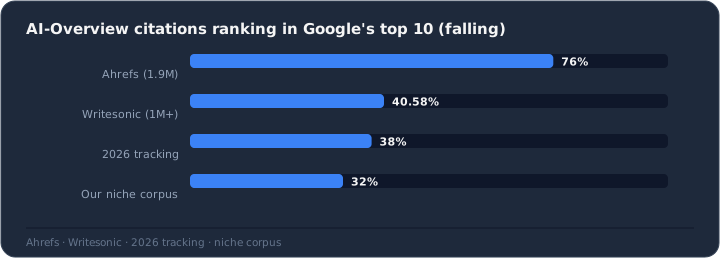
Different corpora, different months, one direction: from three-quarters of citations in the top 10 toward a third.
GEO vs SEO vs AEO: where the disciplines split
SEO wins positions in ranked lists. AEO wins extraction — an existing answer lifted into snippets, People Also Ask, and voice responses. GEO wins synthesis — your brand selected when a model writes a new answer from several sources. The three share one on-page foundation. They split completely on what you count afterward.
The overlap is genuine. So the honest version of this section is a transfer audit, not a turf war. Here is what your existing SEO already covers, and what GEO adds on each layer:
| Layer | Your SEO already covers | GEO adds |
|---|---|---|
| Crawl and index | Googlebot access, sitemaps, canonical hygiene. | AI-crawler access: GPTBot, ClaudeBot, PerplexityBot. Plus WAF rules that block them silently. |
| Content | Pages that rank for mapped keywords. | Self-contained 40–60-word blocks that survive extraction. One per sub-query. |
| Authority | Backlinks and referring domains. | Unlinked third-party mentions: roundups, review platforms, comparison pages engines retrieve. |
| Query model | Keywords with search volume. | Prompts, decomposed by query fan-out into 5–15 sub-queries each. |
| Scoreboard | Positions, clicks, impressions in Search Console. | Citation frequency and share of voice via prompt sampling. Invisible to every GSC report. |
Read the table bottom-up and the split is one sentence: the work converges, the scoreboard diverges. A team can execute the left column perfectly and never learn whether an AI engine names them. No tool in the classic stack counts the right column.
That gap — not the tactics — is what keeps the disciplines distinct. It also decides budget ownership. The content team owns rows two and four. PR owns row three. Someone has to own row five, or nobody does.
In most orgs the fastest path is not a new team. Add the right column to the roadmap your SEO team already runs. Then give generative engine optimization its own line in the reporting, so the new scoreboard survives the next reorg.
The full comparisons run deeper than this table and carry their own SERP evidence. GEO vs SEO covers ranking factors vs citation factors, and where your traffic actually went. AEO vs GEO covers the extraction-vs-synthesis fork. It includes the zero top-10 URL overlap between the two comparison SERPs.
That number settles whether Google thinks they are one topic. A third page completes the set. AEO vs SEO maps what your search team already does against what answer engines ask for. Read the one that matches the fight you are in this quarter.
What actually moves AI citations
Off-site presence moves citations hardest, on the record. One roundup inclusion did what two months of schema and FAQ rewrites could not. On-page, factual density pays: statistics, quotes, and source citations lifted visibility up to 40% in the GEO paper's 10,000-query benchmark. Metadata mostly does not pay. Crawler tests read zero JSON-LD.
This section is the honest weighting the audience keeps asking for. It ranks levers by evidence quality. It names who controls each. It does not hide the negative results.
That is also how we run audits. The intake call usually says "our content is strong, why doesn't ChatGPT know us". The answer, more often than any client expects, sits outside their website.
Off-site: the levers with the strongest record
The cleanest natural experiment in the corpus sits on r/MarketingandAI , dated June 2026. An agency owner ran two months of on-site GEO work for a B2B client. Schema, llms.txt, FAQ restructuring. Zero movement in AI answers. Then the client started getting named in ChatGPT responses.
"I go back to see what we changed and it's nothing on his site," he wrote. A "best [x] companies" roundup had added the client weeks earlier. One third-party inclusion beat the entire on-site checklist.
The pattern repeats across segments. A SaaS founder on r/SaaS ran the category test — "what's the best tool in my category?". He got three competitors and no mention of his own product, despite solid Google rankings.
His verdict after digging: "Being indexed by Google doesn't mean ChatGPT knows you exist. Your G2 and Capterra reviews matter more than your blog posts for AI recommendations". Review signals cut both ways, too. Seer Interactive studied over 800,000 AI answers and found review sites among AI's strongest trust signals near purchase decisions.
One negative review from 2018 was still echoing in AI answers in 2026, because the same complaint sat on several review sites. The Whitespark episode covered the study. Its title for the finding: "AI holds grudges".
On-page: extraction and factual density
The on-page levers are real. They are just second in sequence, not first. The GEO paper's benchmark is still the only controlled tactic test in the field. Across 10,000 queries, three tactics raised visibility 30–40%:
- adding statistics
- adding quotes from credible sources
- citing primary sources
Keyword stuffing produced nothing. Every winning tactic raises factual density per paragraph. That is the property a retrieval filter scores.
Structure decides whether the density gets lifted. A marketer on r/SEO_LLM nailed the failure mode. His words: "It's well researched, answers the query, reads well, and sometimes even ranks decently in Google. Yet it rarely seems to appear in AI-generated answers". Meanwhile simpler pages surface again and again.
The difference is retrieval-shaped writing. Answers stated in the first sentence. Sections that hold exactly one topic. Paragraphs that survive being lifted out of context. Quality for a human reader and liftability for an LLM pipeline are different properties. Only one of them was in your old style guide.
Independent testing keeps landing on the same list. A tester on r/ChatGPT dug into how AI systems pick sources. He wrote it up in February 2026. "ChatGPT seems to prefer clear, definition-first content". "Pages with direct answers at the top are easier to extract". "Structured sections and self-contained paragraphs matter a lot".
And: being "ranked in Google" alone is often not enough. Nothing on that list is exotic. All of it is formatting discipline your current team can ship this quarter. That is why it is step two of the workflow below, not the last step.
The contested signals: schema, metadata, llms.txt
Here the evidence conflicts, so both sides get stated. An r/TechSEO test planted 60+ unique codes across a page's HTML. Then it asked six AI systems to read them. "Meta descriptions. Zero. JSON-LD. Zero. OG tags. Zero. Schema markup. Zero. The only metadata any of them read was the title tag".
AI crawlers turn pages into plain text. The head is gone before the model reads a word. Against that: Google's AI Overviews inherit structured data through the classic index, and Google's own guide recommends it. Both facts are true. Schema helps the surfaces that run on Google's index. It does nothing for direct LLM crawlers.
Budget accordingly. Same posture on llms.txt. One HN user running roughly 80,000 blogs reports no AI crawler asking for the file. Adopters keep publishing counter-anecdotes. We track adoption data rather than preach for either camp.
One technical lever is uncontested and embarrassingly common: access. One team reviewed a few thousand US/UK business sites and posted the result on r/aeo . About 27% blocked at least one major LLM crawler. Usually by accident. At the CDN or WAF layer. Invisible in robots.txt.
E-E-A-T signals, capsules, and citations all score zero on a page the crawler never fetched.
| Lever | Evidence on record | Who controls it |
|---|---|---|
| Third-party roundups | Roundup inclusion flipped ChatGPT presence after two months of on-site work changed nothing (r/MarketingandAI, June 2026). | PR / partnerships. |
| Review platforms | Among AI's strongest trust signals in Seer's 800,000-answer study. A 2018 complaint still echoed in 2026. | Support + ops. |
| Factual density | +30–40% visibility from statistics, quotes, citations across 10,000 queries (arXiv:2311.09735). | Content team. |
| Liftable structure | Retrieval favors first-sentence answers and self-contained blocks. Shown across independent tests. | Content team. |
| Crawler access | ~27% of sites block an LLM crawler by accident at the CDN/WAF level. | Dev team. |
| Schema / metadata | Split verdict. Direct crawlers read zero JSON-LD. Google-index surfaces still use it. | Dev team. |
The weighting, stated without hedge: liftable pages are the precondition, off-site mentions are the multiplier. Run them in that order and neither is wasted. Run mentions onto an unreadable site, or polish a site nobody references, and you bought half a system.
The GEO workflow: audit, extraction, mentions, tracking
A working GEO program runs four steps in order. Audit whether AI engines can read you and whether they mention you today. Rebuild key pages into liftable answer blocks. Earn presence in the third-party sources engines retrieve. Then sample prompts on a fixed cadence and track share.
Teams that jump straight to step three burn the spend twice.
Run the four steps in order. Teams that jump straight to earning mentions burn the spend twice.
Step 1: audit access and current visibility
Start with two questions a free tool answers in minutes. Can AI crawlers fetch your pages? Do AI engines mention you now? The first catches the 27% accidental-block problem before any content work. The second sets the baseline. Check your AI visibility against your top three competitors on ten buying prompts.
Now you have a number to defend in the next budget meeting. The deeper version maps what one marketer on r/aeo calls the citation supply chain. In his words, the winners know "which specific domains and pages are being cited for their most important prompts".
And they know "whether their own content is in that mix or whether someone else's pages are carrying them". That mapping — access, baseline, supply chain — is the deliverable of a GEO audit . It dictates every hour that follows.
Step 2: rebuild for extraction
Take your money pages first, not your whole archive. Under every H2, place a capsule. Forty to sixty words. Self-contained. The heading's question answered with a number or a named fact in the first sentence. Phrase headings the way people prompt, not the way departments talk.
Convert comparisons into tables — models lift structured claims more reliably than prose. Keep the title tag sharp; per the metadata test above, it is the one head element every crawler reads. And render server-side. Content that appears only after JavaScript runs may never reach the retrieval layer at all.
A worked example makes the rewrite concrete. Before: a section titled "Our Approach to Client Success". It opens with "In today's rapidly evolving digital environment, we believe partnership matters". No retrieval filter scores that. It contains zero facts. After: a heading that asks "How much does a GEO audit cost?".
The first line: "A GEO audit runs $49–499 depending on depth: automated snapshot at the low end, full citation-supply-chain mapping at the top. Delivery takes five business days". Price, range, deliverable, timeframe. Four liftable facts in 31 words. The second version can lose a human reader's affection and still win the sub-query. The first can charm every visitor and never get cited once.
Step 3: earn the mentions
Work the supply chain you mapped in step 1. Pitch the roundups and comparison pages that engines already cite in your category. Inclusion there is the single highest-leverage event on record. Build review volume on the platforms your buyers name — G2 and Capterra for SaaS, trade directories elsewhere.
Those reviews outweigh your blog in AI answers. Keep entity facts identical everywhere: one name, one description, one category, across your site, LinkedIn, directories, and profiles. Models merge entities by consistency. And do it under a declared identity.
Research made the rounds in 2026. The headline: "It Is Trivially Easy to Use Reddit to Manipulate AI Search" . Accurate — and beside the point for a brand. Seeded astroturf that gets identified burns the entity trust you are trying to compound. This audience hunts shills for sport.
Step 4: put it on a cadence
Nothing in steps 1–3 stays true for long. Models retrain. Sources rotate. Competitors move. Monthly prompt sampling is the minimum instrument. A sane starting cadence looks like this.
- Forty prompts that mirror real buying questions.
- Four engines: ChatGPT, Perplexity, Gemini, and Google's AI surfaces.
- One fixed day each month.
Save the raw answers, not just the counts — the wording of a mention tells you how the model frames your brand. Expect noise between single runs. Trust the slope, not the point. The metrics to compute from each run are the subject of the next section.
How to measure GEO
GEO tracking samples prompts and counts presence. Three metrics cover it. Brand Visibility: the percentage of sampled answers naming you. AI Share of Voice: your mentions divided by yours-plus-competitors'. Average mention position: where in the answer you appear. Google Search Console sees none of this. Sampling is the only instrument there is.
The formulas, stated precisely — almost nobody publishes theirs. Brand Visibility %: of N prompts sampled across engines, the share of generated answers that name your brand at all. AI Share of Voice : your mention count, divided by total mentions of you plus tracked competitors. Same prompt set. This is the metric that turns "we showed up" into a market position.
Average mention position: where in the answer you appear. First-named tools get the recall and the click. Footnoted ones don't. Together the three give this channel the ROI language it otherwise lacks. Visibility for reach. Share of voice for competition. Position for quality.
Run the arithmetic once and the metrics stop being abstract. Say you sample 40 buying prompts across four engines, and your brand appears in 14 answers. Brand Visibility is 35%. Across those answers you are named 18 times against 42 total mentions of you plus your three tracked competitors. AI Share of Voice is 30%.
Your average mention position is 2.4 — usually second or third named, rarely first. Resample the same prompt set monthly and those three numbers become a trend line a CMO can act on.
Note what counts as proof per engine. Perplexity shows its sources on every answer. ChatGPT citations surface as linked footnotes only when the model actually browsed. Gemini's grounding varies by query. So record mentions and citations separately.
Why sampling and not analytics? Because the channel is structurally invisible to the classic stack. As an Ask HN post on discovery mechanics put it: "Analytics tools show humans. SEO tools show Google." Zero-click search was already eroding the click signal — Pew measured the 46.7% decline where AI Overviews appear.
A mention inside a ChatGPT answer never touches your server logs unless the user clicks a citation. You measure the answer layer by asking it questions, systematically. Or you don't measure it.
Two field notes from our own snapshots. First, variance is real. On July 9, 2026, the same query — this page's keyword — returned an AI Overview in the US, the UK, and Australia. In Canada it returned none. One sample is an anecdote. A monthly series is a metric.
Second, market portability is real too. Six of the seven top-12 US URLs for this term repeat in the British and Canadian top sets. The arXiv paper ranks top-10 in all four English markets. A US-optimized page competes in all of them without localization.
So your prompt sampling should cover engines first, not countries. Start with Perplexity if you need fast proof: its visible citations make it the quickest engine for showing movement to a skeptical CMO. Whether your scoreboard says marketers get cited, SMB owners get recommended, or founders get mentioned — the sampling procedure is the same.
GEO objections answered
The standing objections each have a documented answer. The SEO overlap is real, and the tracking layer is still new. Citation concentration is real, and a third of citations still come from beyond the top 100. The black box is real, and it is samplable. None of the three survives contact with the numbers.
"It's just rebranded SEO"
The steelman deserves its due. Ahrefs argues the everything-is-SEO position openly. The tactical overlap on a single page is near-total. Vendors with the largest datasets confirm that brands winning AI citations usually rank well too. If your team treats GEO as permission to drop SEO fundamentals, the skeptics are right about you.
What the rebrand framing cannot explain is the scoreboard gap. Rankings and citations correlate at 76% in one study, 40.58% in another, 38% in current tracking. A link that weak and that unstable is two systems, not one system with a new name. The delta is concrete.
- The unit shifts from page to passage.
- The query model shifts from keywords to fan-out sets.
- The trust currency shifts from backlinks to unlinked mentions.
- The scoreboard shifts from Search Console to prompt sampling.
Call the discipline whatever survives your next meeting. The delta is what you are budgeting for.
"Only 9% of domains win — small sites can't"
The concentration finding is real and worth taking seriously. One tester tracked 3,311 AI searches and reported the spread. "Out of 6,833 different domains I saw mentioned, just 671 of them (9%) accounted for HALF of all the recommendations". Wikipedia alone took 5.15%. Three counters, all data.
First: half the recommendations concentrating means the other half spreads across 6,000+ domains. And 31% of AI Overview citations come from beyond the organic top 100 — exactly where a young site lives. Second: fan-out multiplies the surface. You don't need to beat Wikipedia on the head term. You need to be the best passage for some of the 5–15 sub-queries.
Third: the counter-example exists on the record. A startup described on HN got inbound leads from Gemini. Google had not yet indexed a single page of its site. "By every traditional SEO metric, we should have been invisible. On Google, we were. On Gemini, apparently not". Concentration is a headwind. It is not a gate.
"You can't measure it, so you can't sell it"
You could not measure it in 2024 with the tools of 2019. That is where this objection fossilized. Today the measurement is a defined procedure. Fixed prompt set. Fixed engine set. Monthly cadence. Three metrics with formulas stated one section up. It runs with a spreadsheet and an hour, or with any of a dozen tracking platforms.
The honest limitation is variance, not visibility. Single samples mislead — see the Canada example above. So commit to a series before drawing conclusions. "We don't know if it works" and "we haven't sampled it yet" are different sentences. Only one of them belongs in a strategy document.
No comments yet