
SEO (search engine optimization) earns organic rankings and clicks in classic search results. AEO (answer engine optimization) earns extraction: your answer lifted into featured snippets, People Also Ask, and AI answers, with attribution . AEO extends SEO rather than replacing it. Same crawlable foundation, different unit of work: the 40–60-word answer block, not the page.
Google returned 98 results for "aeo vs seo" on July 10, 2026 — a 1,900-searches-a-month query. Not one of them holds a featured snippet. The SERP carries zero ads, a four-question People Also Ask block, and an AI Overview citing ten sources. Of those ten, exactly three rank in the organic top-10.
A YouTube Short at #92 made the cut. HubSpot's comparison at #10 didn't. The query about answer optimization is itself an open answer surface. The 98 pages fighting over it mostly re-litigate definitions — 52 titles (53%) are built around "difference" or "differ" — instead of telling a working SEO what changes in the actual work.
- AEO extends SEO rather than replacing it — same crawlable foundation, different unit of work.
- SEO wins a position; AEO wins an extraction — the 40–60-word answer block, not the page.
- 40.58% of AI citations come from Google's top-10 results, per a study of 1 million AI Overviews.
- Rows 1–4 cost a combined effort of 6 and hold three of the four High extraction ratings.
- Zero of six AI crawlers read JSON-LD in the April 2026 test — keep schema for Google surfaces.
That gap is this page's job.
- First the short answer and a side-by-side table.
- Then nine practices scored by effort and impact — a work-planning tool, not a feature list.
- Then the section none of the top-10 pages wrote: which featured-snippet skills transfer to AI answers and which are dead weight.
- Dated business cases close it out.
One boundary up front. This page compares AEO with classic SEO. Weighing AEO against GEO — generative engine optimization, where the target is citations inside synthesized answers and the query model shifts from keyword targeting vs prompt coverage — is a genuinely separate comparison.
The two SERPs shared zero top-10 URLs on July 10, 2026. The nearest miss is Digiday's explainer: #3 there, #11 here. The full evidence, including the vendor fact-check, lives at AEO vs GEO .
The short answer: same foundation, different win condition
SEO wins a position; AEO wins an extraction. On this SERP only seven organic URLs sit inside the top ten positions; SERP features hold the rest.
The #1 organic result is not a guide at all. It's a r/DigitalMarketing thread asking the difference. Google's AI Overview cites that thread as its first source. Extraction in action, on the query about extraction.
| SEO | AEO | |
|---|---|---|
| The win | A position: your page ranks, the user clicks through. | An extraction: your words appear in the answer, source attached. |
| Where it lands | Organic rankings on the classic results page. | Featured snippets, People Also Ask, voice readouts, AI answers. |
| Unit of work | The page and the domain behind it. | The answer block: 40–60 words under a question-phrased heading. |
| Query focus | Keywords with volume; intent match read off the SERP. | Known questions, mapped one-to-one to prepared answers. |
| Payoff | Traffic you can count in analytics. | Visibility that often skips the click. |
| Gatekeeper | Authority: links, history, topical depth. | Format: how liftable the block itself is. |
| Weekly scoreboard | Positions and organic sessions. | Snippet and answer-box share on mapped questions. |
The gatekeeper row carries the verdict. Position influences extraction but doesn't decide it. Writesonic's study of 1 million AI Overviews found 40.58% of AI citations come from Google's top-10 results. Our own niche corpus reads 32%. That is 101 of the 317 AI answer sources we logged across 25 US SERPs in July 2026. The "aeo vs seo" SERP reads 30% — three of the AI Overview's ten sources.
Three datasets, one conclusion: six or seven of every ten citations go to pages that never cracked the top ten. SEO's gate is authority. Extraction's gate is format. That's why AEO is best read as search engine optimization extended to extraction surfaces. It rides the index SEO builds and cannot replace it.
The payoff row is the trade that decides budgets: traffic vs visibility. An SEO win lands in your analytics as a session. An AEO win frequently doesn't. The snippet or AI answer resolves the query on the results page, and your compensation is the attribution.
Whether that trade is worth making is a business question. The market keeps asking it in exactly these words: "is this a genuine strategic evolution or just SEO with a new label?" ( r/AISEOExplained , December 2025). The next two sections answer it with scores instead of adjectives.
The incumbents mostly agree on the frame and split on emphasis. Semrush at #7, page dated September 29, 2025, calls the two symbiotic. SEO builds the domain authority and trust; AEO "makes that content easier for AI systems to parse".
Fifteen of the 98 results (15%) dilute the question into three- and four-way explainers, with GEO, AIO, and LLMO stacked onto one page. That is the surest way to answer none of the comparisons well. The aeo vs seo question is a two-way question about work allocation. It gets a two-way answer here.
The field's shape says one more thing. Twenty of the 98 titles (20%) are phrased as outright questions, and the #1 result is one of them.
When a fifth of a SERP asks instead of answers, the extraction surfaces above it decide who gets read. That is the whole argument for treating format as a first-class deliverable, not a polish step.
AEO practices vs SEO practices: effort and impact, scored
Nine practices cover both disciplines' real to-do lists, and the same task rarely pays both surfaces equally. Each row below gets one effort score and two impact ratings — one for organic rankings, one for extraction. The table works as a scheduling tool: what to do first, what to keep funding, what to stop counting on.
| Practice | Effort (1–5) | Ranking impact | Extraction impact | The evidence |
|---|---|---|---|---|
| Question research: mine People Also Ask, autocomplete, support tickets. | 1 | Moderate — long-tail coverage. | High. Every extractable slot starts as a known question. | This SERP hands you four PAA questions at $0. All four are answered in the FAQ below. |
| Answer capsules under question-phrased headings. | 2 | Neutral to positive. | High. The exact unit engines lift. | Google's own AI Overview on this SERP instructs writers to place "a concise, direct answer" at the very beginning of a section. |
| FAQ and HowTo schema. | 1 | Low — eligibility, not position. | Split: Moderate for Google surfaces, near zero for AI chatbots. | r/TechSEO test , April 1, 2026. Six AI crawlers read JSON-LD zero times. The only metadata any of them read was the title tag. |
| Reformatting pages that already rank: answer-first paragraphs, tables, self-contained H2 sections. | 2 | Neutral. | High. | Seven of the ten AI Overview sources here rank outside the top-10 or off the captured SERP entirely. Format got them in, not position. |
| Technical crawlability and indexation. | 3 | High — table stakes. | High. Extraction reads the index. | Shared substrate. A page that isn't indexed can't be extracted. |
| Topical depth and long-form coverage. | 4 | High. | Moderate. | HubSpot's own split, page dated June 3, 2026. Deep pages rank; short blocks get lifted. |
| Backlink acquisition. | 5 | High. | Indirect — authority feeds source selection. | No controlled data ties links to snippet or AI-answer wins. Budget it as SEO's line item. |
| Freshness cadence: dated updates on money pages. | 2 | Moderate. | Moderate. | 31 of 98 snippets on this SERP (32%) display 2026 dates against 22 showing 2025. The surface skews recent. |
| Title and CTR optimization. | 1 | Moderate. | None. The extracted answer bypasses the click. | Zero-click mechanics. The win is attribution inside the answer, not the click after it. |
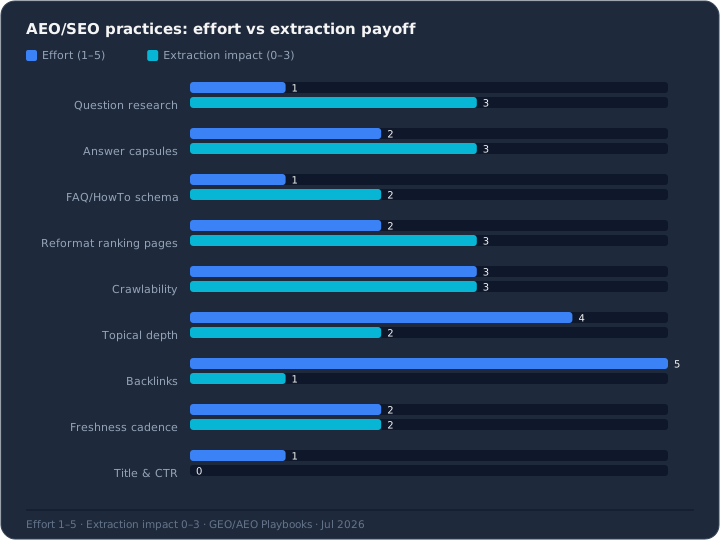
Effort scored 1-5 for a 50-page B2B site. Extraction impact encoded None=0, Low=1, Moderate=2, High=3. The cheapest rows carry the highest extraction payoff.
Read the table as ranking factors vs citation factors and the plan writes itself. Rows 1–4 cost a combined effort of 6 out of a possible 20 and hold three of the four High extraction ratings. That's a two-week sprint for a 50-page site, and it is the entire on-page half of answer engine optimization.
Rows 5–7 are SEO's moat: expensive, slow, and non-negotiable, because extraction consumes the index that SEO builds. Row 9 is the line to stop counting on for AEO specifically. A lifted answer never shows anyone your title tag.
The schema row deserves its own sentence, because it breaks the most assumptions. Structured data still earns its keep on Google's surfaces — rich results, FAQ eligibility, entity disambiguation. What it demonstrably does not do is speak to AI chatbots at crawl time.
In the April 2026 community test, every one of six AI crawlers converted pages to plain text and threw the <head> away before the model read a word. Keep writing schema. Stop selling it as a chatbot lever.
Which snippet-era skills transfer to AI answers — and which don't
Nine skills defined the featured-snippet era. Three transfer to AI answers intact, three need rework, and three are dead weight. No page in the "aeo vs seo" top-10 runs that inventory. HubSpot at #10 contrasts formats. "AEO prioritizes short, extractable answer blocks for AI search, while SEO prioritizes deep, comprehensive pages that rank in search results".
Optimizely at #5 contrasts functions. "SEO helps search engines find your content, whilst AEO helps AI understand and utilize your content". Both statements are accurate. Neither tells a veteran which of the skills they've billed for since 2014 still pay. Here's the payroll review:
| Skill from the snippet era | Verdict | What changes |
|---|---|---|
| PAA and question mining. | Transfers intact. | Same research, bigger payout surface. The questions you mapped for snippets now feed AI answers too. The intent match discipline — known question, prepared answer — is identical. |
| The 40–60-word snippet paragraph. | Transfers intact. | The industry renamed it the answer capsule . Placement tightened: directly under a question-phrased heading, first lines of the section. |
| Tables, steps, and definition formatting. | Transfers intact. | Structured blocks remain the most-lifted format on classic and AI surfaces alike. This SERP's AI Overview itself recommends tables and FAQs for extractability. |
| Schema markup. | Needs rework. | Keep it for Google's surfaces: eligibility and rich results. Retire the claim that it moves chatbots. Zero of six AI crawlers read JSON-LD in the April 2026 test. |
| Rank tracking. | Needs rework. | Position is now a weak proxy for answer presence. 3 of the 10 AI Overview sources here (30%) sit in the top-10. Track answer-box share and AI answer mentions next to positions. |
| Keyword-difficulty triage. | Needs rework. | Add an answerability check to every keyword call. Does the SERP carry PAA and an AI Overview? Is the snippet slot open? On this query it is — no snippet, zero ads. |
| Meta-description craft. | Dead weight. | AI crawlers strip the head section before the model reads anything. 9 of 11 metadata types scored zero in the same test. Write them for humans on classic SERPs; expect nothing else. |
| CTR-bait titles. | Dead weight. | Extraction is zero-click by design. Curiosity-gap headlines optimize a click that the answer surface has already removed. |
| Chasing #1 as the end state. | Dead weight. | The AI Overview on this SERP cites a YouTube Short ranked #92 and skips HubSpot at #10. Position one is a nice-to-have, not the finish line. |
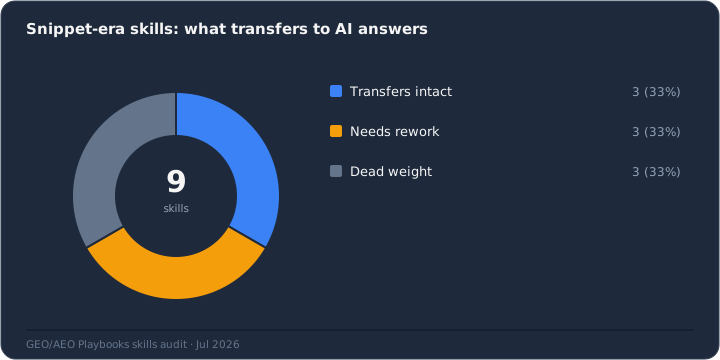
Of nine snippet-era skills, three transfer intact, three need rework, three are dead weight for AI answers.
The net reads better for veterans than the panic suggests. The three intact skills — question mining, capsule writing, structural formatting — were always the hard, craft-heavy part of snippet work. They carry over at full value. What dies is the metadata layer and the click-psychology layer, the parts that were cheapest to fake.
A LinkedIn post at #6 on this SERP states the trap plainly: "People assume optimising for one automatically optimises for the" other. The transfer map shows the assumption is two-thirds right — which is exactly wrong enough to burn a quarter's budget on the dead-weight third.
Format alone guarantees nothing, either. Writesonic sits at #80 on this query, with a 1,968-word comparison built around its own tool pitch. That's the vendor whose million-answer study anchors half the statistics in this niche.
Skills transfer; competition still applies. The pages that hold the top of this SERP answer the question in their first lines and save the sales pitch. That pattern is worth copying under either acronym.
When AEO matters more: three business cases, one counter-case
Three dated practitioner threads supply the triggers. Each maps back to a row of the effort table above. The counter-case matters just as much: AEO spends badly when the trigger isn't there.
Your CTR falls while impressions hold
"After looking google search console, it's clear that CTR is dropped in general… so next step is optimizing for ANSWER ENGINES?" — r/AISEOTricks , April 29, 2026. That pattern — impressions steady, clicks sliding — means extraction surfaces are answering the query upstream of your listing. The rankings didn't fail; the click got intercepted. The response is rows 1–4 of the table.
Map the questions, write the capsules, restructure the pages that already rank, and measure snippet plus answer-box share 30 days later. You either supply the extracted answer or donate the query to whoever does. The same Search Console view also sets the priority order. Sort by impressions where CTR fell hardest: those are the queries already being answered above your listing.
The CMO wants an answer-engine plan by Friday
The canonical version is a SaaS marketer on r/content_marketing , August 2025. The CMO is watching AI Overviews. An agency is about to be hired. The team is "struggling to see how it differs from normal SEO" under a pile of "Linkedin corporate fluff".
The budget-defense answer: AEO is not a new department. It's the existing content team executing rows 1–4 — roughly two weeks of work. The scoreboard is one the CMO can audit: answer-box share on mapped questions, before and after.
Present the trade honestly as traffic vs visibility: some of these wins will never show up as sessions. Compare AEO tools before signing an agency retainer. Most of what a retainer bills for in month one is the question-mapping row you can run in an afternoon.
You're a young domain staring at a keyword-difficulty wall
Across the six freshest commercial SERPs in this niche — July 2026 snapshots — not one carries a featured snippet. Every one carries People Also Ask. The ad count is zero on all six. AI Overviews sat on 30 of 34 US niche SERPs, 88%. The extraction real estate is open on exactly the queries where positions are hardest to win.
And extraction is format-gated rather than authority-gated : this page's own SERP cites a personal blog that doesn't appear anywhere in the 98 captured organic results. For a domain that can't out-link incumbents, capsule wins arrive before position wins. Sample where you already show up — check your AI visibility . Then write capsules for the open slots the sample exposes.
The counter-case: when classic SEO still leads
Transactional and navigational queries without AI surfaces still resolve the old way: a ranked page and a click. And everything AEO does rides on SEO's infrastructure. Calling them complementary strategies isn't diplomacy; it's mechanics. Extraction consumes the index , so de-funding the substrate starves the surface you're optimizing for.
A brand query, a pricing page, a login lookup — none of these needs a capsule; they need the classic result to load, rank, and convert. A hybrid search strategy ships both on one page: the deep page holds the ranking, the capsules inside it get lifted.
That's why the effort table splits impact into two columns instead of declaring a winner. The future of search, on this evidence, is not SEO's funeral. It's the results page as it already looks in 2026: ranked links, extracted answers, and a generated summary sharing one screen.


No comments yet